
Google Ads for Online Stores: A Complete Guide to Increasing eCommerce Sales

Running an online store is not just about listing products and waiting for customers to make purchases. With thousands of businesses competing for attention, reaching the right audience requires an effective digital advertising strategy. Google Ads for online stores provides an excellent opportunity to connect with potential customers who are actively searching for products, compare different options, and encourage them to complete purchases.
Google Ads allows eCommerce businesses to promote their products through search results, Shopping advertisements, display networks, and other advertising formats. When campaigns are properly planned, businesses can increase website traffic, attract qualified visitors, improve conversion rates, and generate more revenue. Whether you operate a small online shop or a large eCommerce business, understanding how Google advertising works can help you build a more profitable online presence. In this guide, we will explore different advertising strategies, Shopping campaigns, keyword targeting, conversion tracking, and optimization techniques that can help online retailers achieve better results.
Google Ads for eCommerce Businesses
Google Ads for online stores is an effective advertising solution that helps eCommerce businesses reach potential customers at different stages of their buying journey. Unlike traditional advertising, where businesses often promote products to a broad audience, Google Ads allows retailers to target people based on their search queries, interests, location, and online behavior. For example, if someone searches for wireless headphones, an online electronics store can display an advertisement for its products directly in the search results. This increases the possibility of attracting visitors who already have an interest in purchasing that particular item.
One of the biggest advantages of using Google Ads is its flexibility. Businesses can create campaigns according to their advertising budgets, product categories, and marketing objectives. Small retailers can begin with a limited budget and gradually increase their spending as they identify successful campaigns. Another important benefit is the ability to measure advertising performance. Store owners can evaluate impressions, clicks, conversion rates, and sales to understand which advertisements are generating valuable results. This makes it easier to improve campaigns and avoid unnecessary advertising expenses.
However, successful advertising also depends on the overall marketing approach. Combining paid campaigns with effective online store marketing can help businesses create a consistent customer experience and build stronger relationships with their target audience.
Google Shopping Ads for Online Stores
Google Shopping Ads are particularly valuable for retailers because they display product images, prices, store names, and other relevant information directly in Google’s shopping results. These advertisements allow customers to compare products before visiting an online store. For Google Ads for online stores, Shopping campaigns can be an important source of high-intent traffic. Customers searching for a specific product are often closer to making a purchasing decision than people browsing general information.
To run successful Shopping campaigns, businesses need to create and maintain a product feed through Google Merchant Center. This feed contains important product information, including titles, descriptions, prices, availability, images, and product identifiers. Accurate product information helps Google understand what a store sells and when its products should appear in relevant searches. Product titles should include meaningful details such as brand names, product types, sizes, colors, and important specifications.
High-quality images are equally important. Since customers can see product images before clicking advertisements, clear and professional photography can improve engagement and attract more relevant visitors. Retailers should also regularly review product performance. Some products may generate many clicks but very few purchases, while others may produce consistent sales. Understanding these differences allows businesses to allocate their advertising budgets more effectively.
Google Ads Campaign Strategy for eCommerce
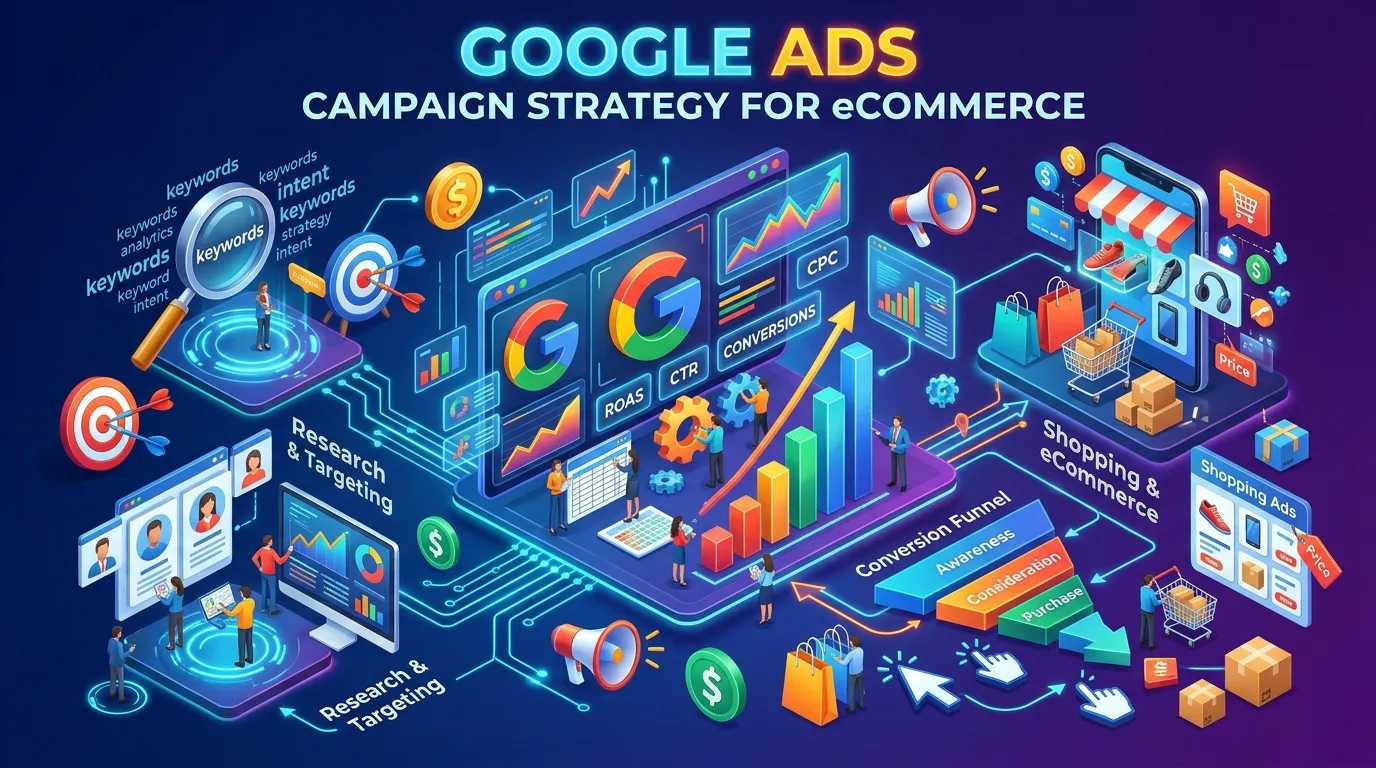 A successful advertising campaign requires more than creating advertisements and setting a daily budget. Businesses need a clear strategy that connects their advertising objectives with customer expectations and purchasing behavior. When developing Google Ads for online stores, the first step is identifying the campaign’s primary goal. Some businesses want to increase overall sales, while others may focus on promoting new products, attracting first-time customers, or clearing seasonal inventory.
Campaign structure is another important consideration. Retailers should organize campaigns around product categories, brands, profit margins, or customer demand. This makes performance analysis easier and provides better control over advertising budgets. For example, a clothing store might create separate campaigns for men’s clothing, women’s clothing, footwear, and accessories. This approach allows the business to evaluate each category independently and adjust spending based on profitability.
Businesses should also consider customer purchasing behavior. Someone searching for a product for the first time may need additional information, while a returning visitor may be ready to purchase. Using suitable advertising formats for different stages of the buying journey can improve campaign effectiveness. A complete marketing strategy should also include other digital channels. Businesses can explore digital products for entrepreneurs to understand how digital offerings and online business models can create additional growth opportunities.
Best Google Ads Strategies for Online Retailers
Online retailers need advertising strategies that focus on reaching relevant customers while maintaining profitable acquisition costs. The best approach depends on the type of products being sold, competition, available budgets, and customer demand. One effective strategy is to prioritize products with strong sales potential. Instead of distributing the entire advertising budget equally across every product, retailers should identify products with healthy profit margins, consistent demand, and competitive pricing.
Remarketing is another valuable strategy. It allows businesses to reconnect with people who previously visited their websites, viewed products, or added items to their shopping carts without completing a purchase. For Google Ads for online stores, remarketing can help maintain brand visibility and encourage interested visitors to return. For example, a customer who viewed a particular smartphone may later see an advertisement reminding them about that product.
Seasonal advertising can also produce positive results. During holidays, special shopping events, and promotional periods, customer demand often increases. Retailers can prepare dedicated campaigns featuring relevant products, attractive offers, and timely messaging. Businesses should also experiment with different advertising formats. Search campaigns, Shopping campaigns, Performance Max, and remarketing campaigns each serve different purposes. Testing these formats helps retailers discover which combinations deliver the strongest results.
E- Commerce PPC Advertising
 Pay-per-click advertising, commonly known as PPC, is a digital advertising model in which advertisers generally pay when someone clicks on their advertisements. Google Ads is one of the most widely used platforms for this approach because it provides access to people actively searching for products and services. E- Commerce PPC advertising can help businesses generate targeted website traffic without waiting for organic search rankings to improve. This is particularly useful for newly launched online stores that want to introduce their products to potential customers. However, generating clicks is not the same as generating sales. Businesses need to ensure that advertisements attract visitors who are genuinely interested in purchasing their products.
For Google Ads for online stores, PPC performance should be evaluated using more than click-through rates. Conversion rates, cost per acquisition, average order value, and return on ad spend provide a clearer picture of campaign profitability. Landing page quality also plays an important role. When visitors click an advertisement, they should arrive at a page that matches the product or offer mentioned in the advertisement. Relevant product information, transparent pricing, customer reviews, and a simple checkout process can improve purchasing confidence. Retailers should regularly review their PPC expenses and compare them with actual revenue. This helps identify campaigns that are consuming advertising budgets without generating sufficient business value.
Google Ads Conversion Tracking for Online Stores
Conversion tracking is essential for understanding whether advertising campaigns are achieving their intended objectives. Without accurate tracking, businesses may know how many people clicked their advertisements but remain uncertain about how many completed purchases. Google Ads for online stores becomes more effective when conversion tracking is properly configured. Retailers can track important customer actions, including completed purchases, add-to-cart events, checkout initiation, and other valuable interactions.
Google Ads conversion tracking can be implemented using Google Tag Manager, Google tags, and relevant eCommerce platform integrations. For more advanced measurement, businesses can also use enhanced conversions to improve the accuracy of conversion reporting when supported and configured appropriately. Purchase tracking deserves particular attention because it helps businesses understand which campaigns generate actual revenue. Ideally, the purchase event should include accurate transaction values, currency information, and transaction identifiers to support reliable reporting and prevent duplicate purchase counting.
For example, if a campaign generates 100 clicks but only two purchases, the business can investigate whether the targeting, product pricing, landing page, or checkout experience needs improvement. Accurate tracking also supports automated bidding strategies. Google uses conversion information to identify patterns and help optimize campaign delivery toward valuable customer actions. Retailers should regularly test their tracking setup to ensure that purchase data is recorded correctly. Reliable measurement creates a stronger foundation for future advertising decisions.
Google Ads Optimization for Online Sales
Launching advertising campaigns is only the beginning. Continuous optimization is necessary to improve performance, manage costs, and increase sales over time. Effective Google Ads for online stores requires regular analysis of campaign data. Businesses should examine which products receive the most engagement, which keywords attract relevant visitors, and which campaigns generate profitable purchases.
One important optimization technique is reviewing search terms. Some search queries may generate clicks without attracting customers who are interested in the products being sold. Adding irrelevant terms as negative keywords can help reduce wasted spending. Bidding strategies should also match business objectives. For example, retailers with reliable conversion data may consider automated strategies such as Maximize Conversion Value or Target ROAS. New campaigns, however, may need sufficient data before advanced bidding strategies can perform consistently.
Another important factor is the quality of the online shopping experience. Slow-loading pages, confusing navigation, unexpected delivery charges, and complicated checkout procedures can discourage customers from completing purchases. Retailers should also test different product descriptions, promotional messages, images, and landing page layouts. Small improvements across the customer journey can produce meaningful results over time. Businesses looking to improve their broader marketing performance can also explore email marketing automation, which helps maintain communication with customers and encourage repeat purchases after their initial interaction with an online store.
Google Merchant Center for eCommerce
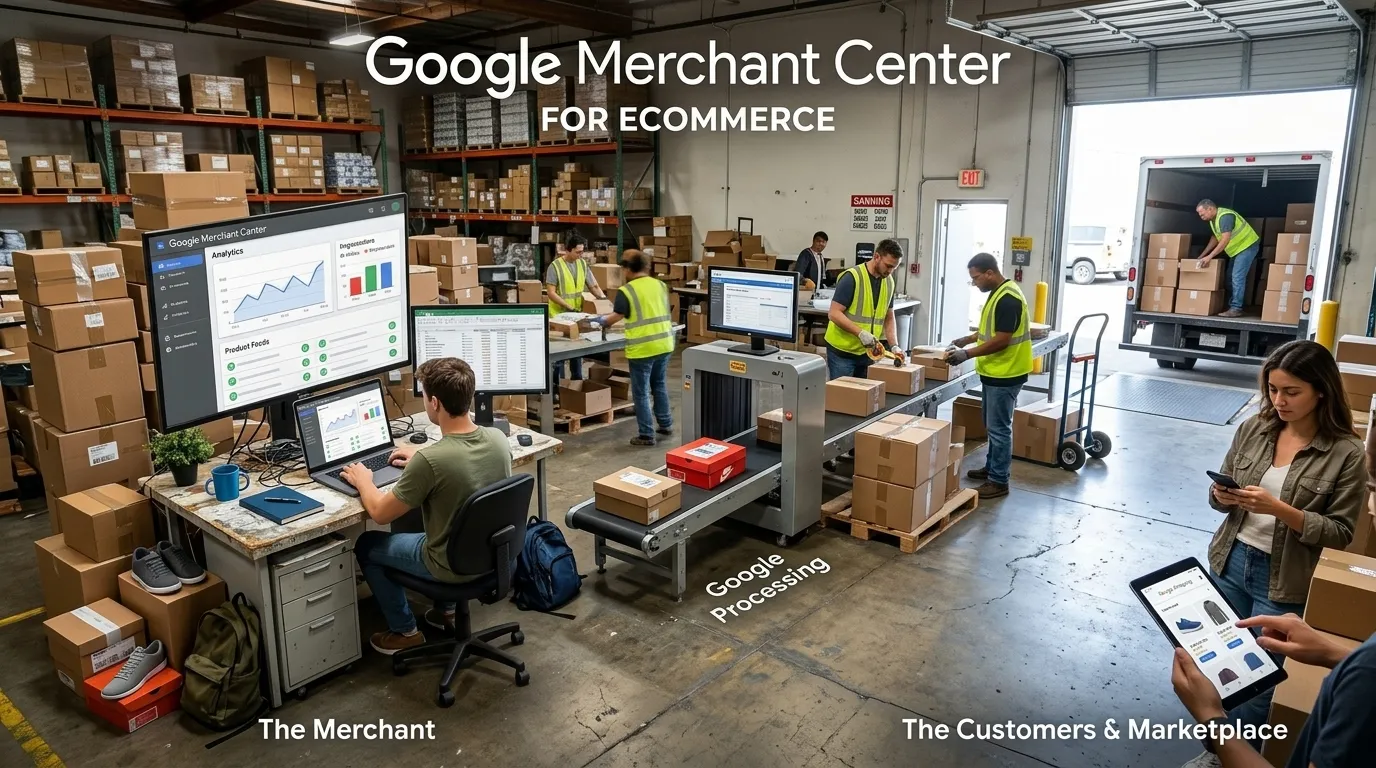 Google Merchant Center is an important platform for online retailers who want to showcase their products across Google’s shopping experiences. It allows businesses to upload product information and make that information available for eligible Shopping advertisements and other supported product listings. For Google Ads for online stores, Merchant Center helps connect product catalogs with advertising campaigns. Retailers can provide product details such as titles, descriptions, prices, availability, images, brand information, and identifiers.
Setting up Merchant Center requires accurate business information and compliance with Google’s shopping policies. The website should provide clear contact details, transparent return and refund policies, secure checkout functionality, and accurate product information. Product feed quality is another major consideration. Incomplete descriptions, incorrect pricing, missing images, and inconsistent availability information can create problems during product review and campaign delivery.
Retailers should regularly synchronize their product feeds with their websites. If a product becomes unavailable or its price changes, the information submitted to Merchant Center should reflect the latest details. Businesses with large product catalogs can use scheduled feed uploads or supported platform integrations to simplify product management. A well-maintained Merchant Center account helps retailers organize their product information and build a stronger foundation for Shopping advertisements.
Google Ads Keyword Targeting for Online Shops
Keyword targeting helps businesses connect their advertisements with people searching for relevant products. Choosing appropriate keywords is important because it influences which searches can trigger advertisements and how relevant the resulting traffic may be. When planning Google Ads for online stores, retailers should consider the difference between broad informational searches and purchase-focused searches.
For example, someone searching for “what are running shoes” may be looking for general information, while someone searching for “buy Nike running shoes online” is demonstrating a stronger purchasing intention. Businesses should conduct keyword research based on their products, customer needs, and competition. Relevant search terms can include product names, brands, categories, specifications, colors, sizes, and buying-related phrases.
Google Ads provides different keyword match types, including broad match, phrase match, and exact match. Each offers different levels of flexibility in matching searches with targeted keywords. Negative keywords are equally important because they help prevent advertisements from appearing for irrelevant searches. A retailer selling premium products, for instance, may want to exclude certain unrelated searches that consistently attract low-quality traffic. Retailers should also review actual search term reports to understand how customers discover their products. This information can reveal new keyword opportunities and help improve campaign targeting.
How to Increase Online Sales with Google Ads
Increasing online sales requires a combination of relevant advertising, competitive products, attractive offers, and a positive shopping experience. Google Ads can bring potential customers to a store, but the website must provide enough value and confidence to turn visitors into buyers. Google Ads for online stores can support sales growth by connecting product advertisements with customers who are actively searching for relevant items. However, businesses should focus on the entire purchasing journey rather than measuring success through website traffic alone.
Product pricing is an important factor. Customers frequently compare prices, shipping costs, product specifications, and return policies before deciding where to purchase. Retailers should communicate their value clearly and make important information easy to find. Trust is equally important. Customer reviews, secure payment options, transparent policies, and accurate product descriptions can reduce hesitation and improve purchasing confidence.
Businesses should also create compelling offers when appropriate. Seasonal discounts, free shipping thresholds, bundle deals, and limited-time promotions can encourage customers to complete purchases. Beyond paid advertising, retailers can build a stronger online presence by following relevant social media viral trends. Creative social media campaigns can introduce products to new audiences and support brand awareness across multiple digital channels.
Businesses can also learn from other advertising approaches, such as the benefits of television advertising, to understand how different promotional channels contribute to brand recognition and customer reach. For long-term success, retailers should combine paid campaigns with broader business growth strategies. This creates opportunities to attract new customers, improve retention, and build a more sustainable eCommerce business. Ultimately, increasing sales is about understanding customers and continuously improving the advertising experience. Retailers who monitor campaign performance, maintain accurate tracking, and invest in high-quality shopping experiences are better positioned to achieve consistent growth.
Conclusion
Google Ads provides online retailers with powerful opportunities to reach potential customers, promote products, and increase eCommerce revenue. From Shopping campaigns and Merchant Center to keyword targeting, conversion tracking, and continuous optimization, every part of the advertising process contributes to overall campaign performance. By developing a clear strategy, understanding customer purchasing behavior, and monitoring important performance metrics, businesses can make better advertising decisions. Combining paid advertising with other digital marketing channels can further strengthen brand visibility and customer relationships. For retailers looking to grow their online businesses, investing in a well-planned Google advertising strategy can be an important step toward achieving sustainable sales growth.
FAQ
1. What are Google Ads for online stores?
Google Ads for online stores is an online advertising approach that helps eCommerce businesses promote their products through Google Search, Shopping advertisements, Display campaigns, and other supported advertising formats. It helps retailers reach potential customers who are searching for relevant products and encourages them to visit their websites and make purchases.
2. Are Google Shopping Ads effective for eCommerce businesses?
Yes, Google Shopping Ads can be highly effective because they display product images, prices, and store information directly in shopping results. These details help customers compare products before visiting a retailer’s website, making Shopping campaigns valuable for attracting purchase-focused traffic.
3. How much should an online store spend on Google Ads?
The advertising budget depends on the business’s product prices, profit margins, competition, and sales objectives. Small businesses can start with a manageable daily budget, evaluate their results, and gradually increase spending when campaigns demonstrate profitable performance.
4. Do I need Google Merchant Center to run Shopping Ads?
Yes, Google Merchant Center is generally required to submit product information for Google Shopping Ads. It allows retailers to manage product feeds and connect their catalogs with eligible Google advertising services.
5. How can I increase sales through Google Ads?
Businesses can improve sales by targeting relevant keywords, creating effective Shopping campaigns, optimizing product pages, using remarketing, and tracking purchases accurately. Regular performance analysis also helps identify opportunities to improve advertising profitability.
6. What is the best Google Ads campaign type for online stores?
There is no single campaign type that works best for every retailer. Shopping and Performance Max campaigns can help promote product catalogs, while Search campaigns can target specific purchase-related searches. The most suitable option depends on business goals, available data, and product categories.
7. What is conversion tracking in eCommerce advertising?
Conversion tracking measures valuable customer actions resulting from advertising campaigns. For online retailers, these actions commonly include purchases, add-to-cart events, and checkout activities. It helps businesses understand which campaigns generate sales and revenue.
8. How long does it take to see results from Google Ads?
Some campaigns can generate clicks and purchases shortly after launch, but achieving consistent and profitable performance may take several weeks or longer. The timeframe depends on competition, budget, conversion tracking, website quality, and the amount of available campaign data.
9. Are Google Ads better than social media advertising for online stores?
Both advertising channels offer different advantages. Google Ads can reach people actively searching for products, while social media advertising can introduce products to audiences based on their interests and behaviors. Many eCommerce businesses benefit from combining both approaches.
10. Can small online stores compete with large eCommerce brands using Google Ads?
Yes, small online stores can compete by focusing on specific product categories, relevant keywords, niche audiences, competitive pricing, and high-quality customer experiences. Careful budget management and continuous campaign optimization can help smaller retailers attract valuable customers without matching the advertising budgets of large brands.