CPA vs CPC vs CPL vs CPM in Affiliate Marketing
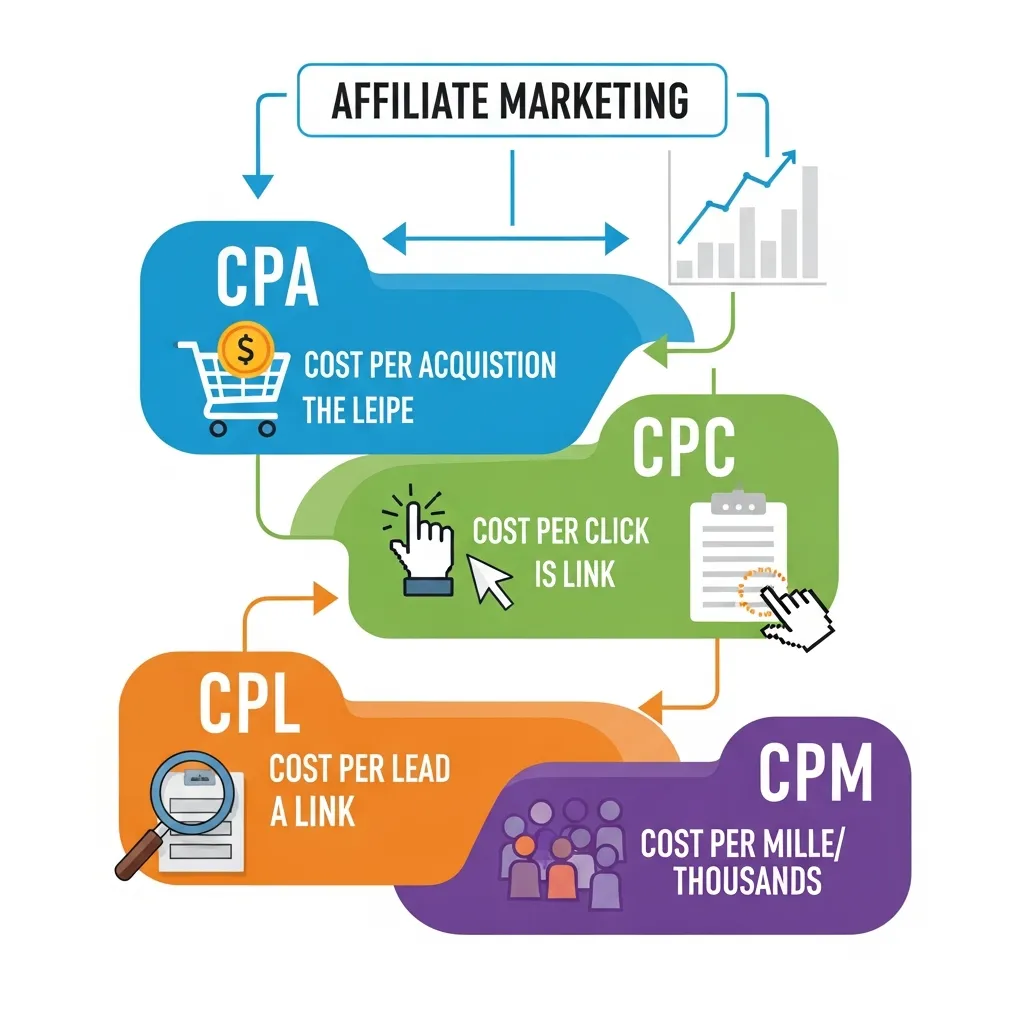
CPA vs CPC vs CPL vs CPM are the four core payment models in affiliate marketing. CPA pays per completed action, CPC per click, CPL per lead generated, and CPM per 1,000 impressions. Choosing the right model depends on your campaign goals, risk tolerance, and audience size.
Affiliate marketing generated over $8.2 billion in the U.S. alone in 2022 (Statista), and that number keeps climbing. But behind every successful affiliate campaign is a critical decision that most beginners overlook: which payment model to use.
CPA vs CPC vs CPL vs CPM in affiliate marketing—these four acronyms might look similar, but they represent fundamentally different approaches to earning and spending money online. Choose the wrong one, and you’ll either burn your budget or leave serious money on the table.
This guide breaks down each model in plain terms: what it is, how it works, where it excels, and where it falls short. Whether you’re an affiliate marketer trying to maximize earnings or an advertiser looking to reduce wasted spend, understanding these payment structures is non-negotiable.
By the end, you’ll know exactly when to use each model, how to avoid the most critical SEO mistakes in affiliate content, and how data reporting can transform your affiliate marketing performance.
What Is Affiliate Marketing—and Why Do Payment Models Matter?
Affiliate marketing is a performance-based marketing channel where advertisers pay third-party publishers (affiliates) to drive traffic, leads, or sales. The affiliate earns a commission each time a user completes a specific action defined by the advertiser.
The payment model determines what that action is. It shapes everything: how affiliates get compensated, how advertisers manage risk, and how both parties measure success. A mismatch between your business goals and your payment model is one of the fastest ways to lose money in affiliate marketing.
Cost Per Action (CPA) in Affiliate Marketing — The Performance King
What is CPA in affiliate marketing, and how does it work?
Cost Per Action (CPA) is a payment model where affiliates earn a commission only when a user completes a specific, predefined action. That action might be a purchase, a subscription sign-up, an app download, or a form submission.
For example, an e-commerce brand might offer a $30 CPA for every sale an affiliate drives. The affiliate earns nothing unless that sale happens. CPA is the backbone of performance marketing because it ties payment directly to results.
What are the advantages of CPA affiliate marketing?
- Low risk for advertisers: Payment is only triggered by measurable outcomes, making CPA highly budget-efficient.
- High earning potential for affiliates: Commissions per action are typically much higher than CPC or CPM payouts.
- Clear performance accountability: Both parties know exactly what success looks like.
What are the disadvantages of CPA in affiliate marketing?
- Higher barrier to entry: Affiliates must drive high-quality, converting traffic—not just volume.
- Conversion tracking complexity: Accurate attribution across devices and browsers can be technically demanding.
How do you optimize a CPA affiliate marketing campaign?
Focus on traffic quality over quantity. Test landing pages aggressively, align your content with high-intent keywords, and ensure your tracking pixels are firing correctly. CPA marketing rewards affiliates who understand their audience’s buying behavior.
Cost Per Click (CPC) Affiliate Marketing — Driving Traffic at Scale
What is CPC in affiliate marketing, and how does click tracking work?
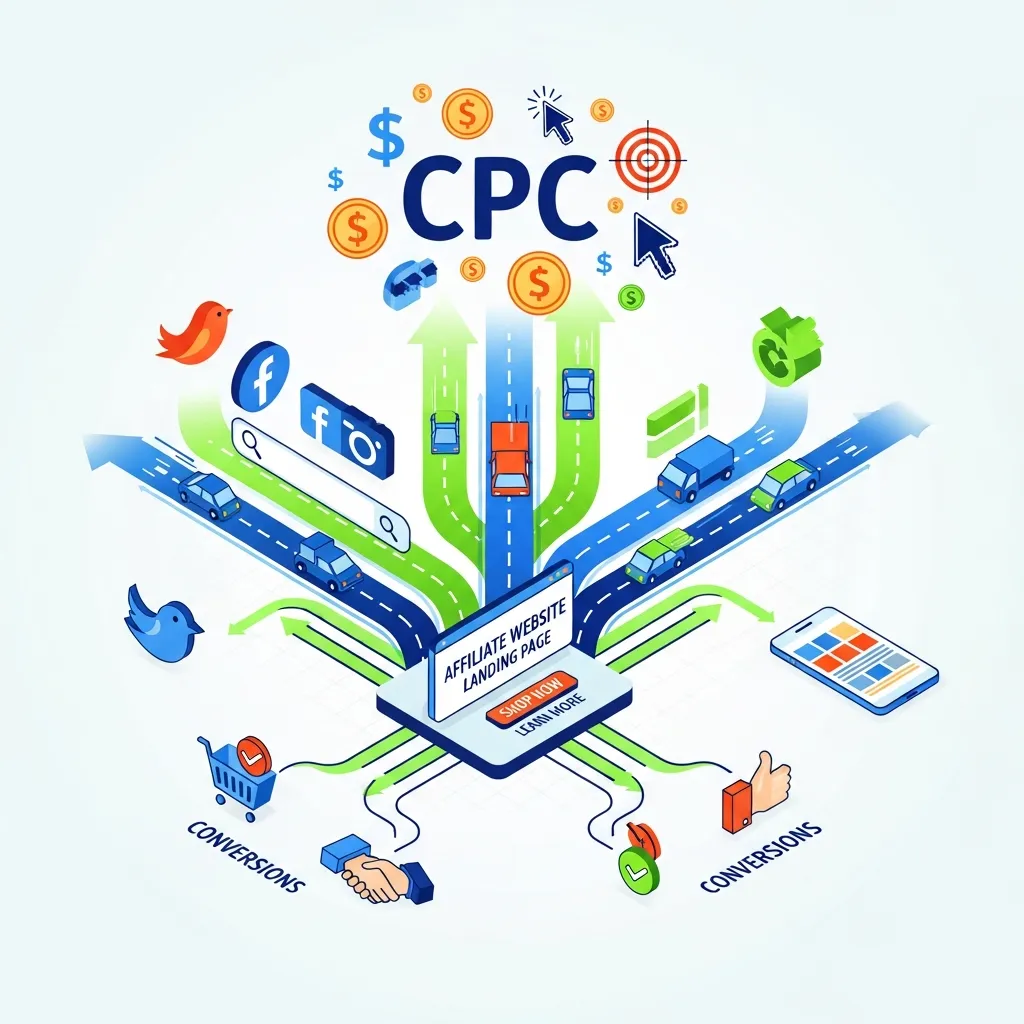
In Cost Per Click (CPC) affiliate marketing, advertisers pay a fixed or variable rate each time a user clicks on an affiliate link or ad—regardless of what happens after the click. CPC is widely used in search advertising, display networks, and comparison websites.
Google Ads operates primarily on a CPC model. Affiliates running paid traffic campaigns will be familiar with bidding on keywords and paying per click received.
What are the main advantages of CPC affiliate marketing?
- Simple to understand and implement: CPC is straightforward—you get paid for clicks, full stop.
- Effective for brand awareness: Even non-converting clicks expose users to a brand.
- Predictable volume: Affiliates can forecast earnings based on traffic data.
What are the risks of CPC affiliate marketing?
- Click fraud: Invalid or bot-generated clicks inflate costs without delivering value. According to ClickCease, click fraud affects up to 14% of paid search campaigns.
- Lower payouts: CPC commissions are significantly smaller than CPA payouts on a per-event basis.
Advanced techniques for CPC affiliate marketing campaigns
Optimizing ad copy and landing page alignment is critical. A high Quality Score in Google Ads reduces your cost-per-click while improving ad placement. Bid management strategies—like dayparting and device targeting—help allocate budget toward your highest-converting segments.
Cost Per Lead (CPL) — Building a Qualified Audience
What is CPL in affiliate marketing, and what counts as a lead?
Cost Per Lead (CPL) pays affiliates for every qualified lead they generate. A lead is typically defined as a user who provides contact information—an email address, a phone number, or a completed form submission.
CPL is popular in industries like financial services, insurance, SaaS, and education, where the sales cycle is long and building a pipeline of prospects matters more than immediate conversions.
What are the benefits of CPL affiliate marketing?
- Qualified prospects: Unlike CPM or CPC, CPL filters users who have shown genuine interest.
- High value in niche markets: In sectors like B2B SaaS or mortgage lending, a single qualified lead can be worth hundreds of dollars.
What are the challenges of CPL campaigns?
- Lead quality verification: Not all leads convert to sales. Advertisers must audit lead quality to avoid paying for junk submissions.
- Potential for low downstream conversion: A high lead volume doesn’t guarantee revenue. Affiliates and advertisers should agree on quality benchmarks upfront.
How do you maximize CPL campaign success?
Use multi-step forms to pre-qualify leads before submission. Segment your audience tightly, and use retargeting to re-engage users who abandoned the form. Clear value propositions—like a free resource or discount—significantly improve opt-in rates.
Cost Per Mille (CPM) — Maximizing Reach and Brand Exposure
What is CPM in affiliate marketing, and how are impressions counted?
CPM stands for Cost Per Mille (Latin for “thousand”). Advertisers pay a set rate for every 1,000 impressions their ad receives—regardless of clicks or conversions. CPM is primarily a brand awareness tool.
Display advertising networks like Google Display Network and Meta Ads operate heavily on CPM pricing.
What makes CPM valuable in affiliate marketing?
- Broad reach at scale: CPM campaigns can expose a brand to millions of users cost-effectively.
- Ideal for product launches: When awareness is the primary goal, CPM delivers volume faster than CPA or CPL.
What are the limitations of CPM campaigns?
- No direct performance guarantee: Impressions don’t equal engagement or revenue.
- Difficult ROI measurement for direct sales: Attributing a sale to a CPM campaign requires sophisticated multi-touch attribution modeling.
When should you use CPM in affiliate marketing?
Use CPM when launching a new product, entering a new market, or running retargeting campaigns to reinforce brand recognition. CPM works best as part of a broader funnel strategy, paired with CPC or CPA for lower-funnel conversions.
CPA vs CPC vs CPL vs CPM: Key Differences and When to Choose Each
|
Model |
Paid For |
Best For |
Risk Level |
|---|---|---|---|
|
CPA |
Completed action (sale, sign-up) |
Performance-driven campaigns |
Low for advertisers |
|
CPC |
Each click on an ad/link |
Traffic generation |
Medium |
|
CPL |
Lead form submission |
Pipeline building |
Medium |
|
CPM |
Every 1,000 impressions |
Brand awareness |
Higher for advertisers |
Choose CPA if maximizing ROI and minimizing wasted spend is your priority. CPA is ideal when you have a proven funnel and want to pay only for results.
Choose CPC if you need to drive targeted traffic quickly and have confidence in your landing page’s conversion rate.
Choose CPL if you’re in a high-value niche with a long sales cycle and need to build an email list or prospect database.
Choose CPM if brand visibility is the primary goal—especially for new products or markets where awareness precedes intent.
What are hybrid affiliate marketing payment models?
Many advanced affiliate programs combine models. A hybrid CPA+CPL structure, for example, pays a small amount per lead and a larger commission per sale. This balances risk between advertiser and affiliate while incentivizing quality traffic.
How Data Reporting Can Transform Your Affiliate Marketing Performance

Data reporting can transform affiliate marketing from guesswork into a precision science. Without accurate analytics, you’re optimizing blind.
What key metrics should affiliate marketers track?
- Conversion Rate (CVR): The percentage of clicks or leads that become paying customers.
- Earnings Per Click (EPC): Average revenue generated per click—a universal benchmark for affiliate program quality.
- Return on Ad Spend (ROAS): Total revenue divided by total ad spend.
- Click-Through Rate (CTR): Measures ad or content engagement.
How can data analytics improve affiliate campaign optimization?
Platforms like Google Analytics 4, Voluum, and Impact Radius provide granular data on traffic sources, user behavior, and conversion paths. Use cohort analysis to identify which traffic sources produce the highest lifetime value customers—not just the highest initial conversion rates.
A/B testing landing pages, offers, and creative assets based on live data is the fastest way to improve CPA and CPL campaign performance.
Avoiding Critical SEO Mistakes in Affiliate Marketing
Critical SEO mistakes can silently kill an affiliate site’s organic traffic. Here are the most common ones—and how to avoid them.
What are the most common SEO pitfalls in affiliate content?
- Thin content: Google’s Helpful Content system penalizes affiliate pages that add little original value. Every page should offer genuine insight beyond what the merchant’s own site provides.
- Over-optimized anchor text: Exact-match anchor text in every backlink is a red flag. Diversify with branded and natural anchors.
- Ignoring E-E-A-T: Google’s quality guidelines emphasize Experience, Expertise, Authoritativeness, and Trust. Affiliate sites should demonstrate first-hand product experience.
- Slow page speed: Core Web Vitals are a confirmed ranking factor. Use tools like PageSpeed Insights to identify and fix performance bottlenecks.
- Keyword cannibalization: Multiple pages targeting the same keyword compete against each other. Consolidate overlapping content with canonical tags or 301 redirects.
Best practices for SEO in affiliate content
Focus on search intent alignment. A page targeting “best CRM software” should serve comparison content—not a single product review. Build topical authority by covering a niche comprehensively rather than chasing high-volume keywords in isolation.
E-Commerce and Internet Marketing: A Synergistic Relationship
Affiliate marketing and e-commerce are deeply intertwined. E-commerce brands rely on affiliate partners to extend their reach without proportional increases in marketing spend.
How does affiliate marketing drive e-commerce sales?
Affiliates act as an outsourced sales force. A single well-placed review from a high-authority affiliate can drive hundreds of qualified buyers to a product page. According to the Performance Marketing Association, affiliate marketing drives 16% of all U.S. e-commerce sales.
How do you integrate affiliate strategies with broader internet marketing efforts?
The most effective affiliate programs complement—rather than cannibalize—owned channels. E-commerce brands should use CPA affiliate marketing for bottom-funnel conversions, CPM for retargeting, and CPL campaigns to build email lists that feed into owned marketing funnels.
Creative Marketing Ideas for Affiliate Campaigns
Standing out in a saturated affiliate market requires more than swapping out banner ads.
What are the most effective creative approaches for affiliate promotion?
- Video reviews and tutorials: YouTube affiliate content consistently outperforms static blog posts for purchase-intent keywords.
- Comparison tools: Interactive widgets that let users compare products (e.g., insurance quotes, SaaS pricing) generate highly qualified CPL and CPA conversions.
- Email sequences: Building an engaged list and promoting affiliate offers via segmented email campaigns delivers consistently high EPC.
- User-generated content (UGC): Authentic customer testimonials embedded in affiliate content improve trust signals and conversion rates.
Advanced CPA Marketing Strategies
What advanced tactics improve CPA marketing performance?
Beyond basic traffic generation, advanced CPA marketing involves funnel architecture. High-performing CPA affiliates build multi-step pre-sell pages that warm up cold traffic before sending users to an advertiser’s offer. This dramatically improves conversion rates.
Geo-targeting is another powerful lever. CPA rates vary significantly by country. Affiliates who optimize traffic routing by geography—sending U.S. traffic to higher-paying U.S. offers—can double their effective CPA earnings without changing their traffic volume.
Verticals with consistently strong CPA performance include financial products (credit cards, loans), insurance, software subscriptions, and health and wellness supplements.
The Bottom Line on CPA vs CPC vs CPL vs CPM in Affiliate Marketing
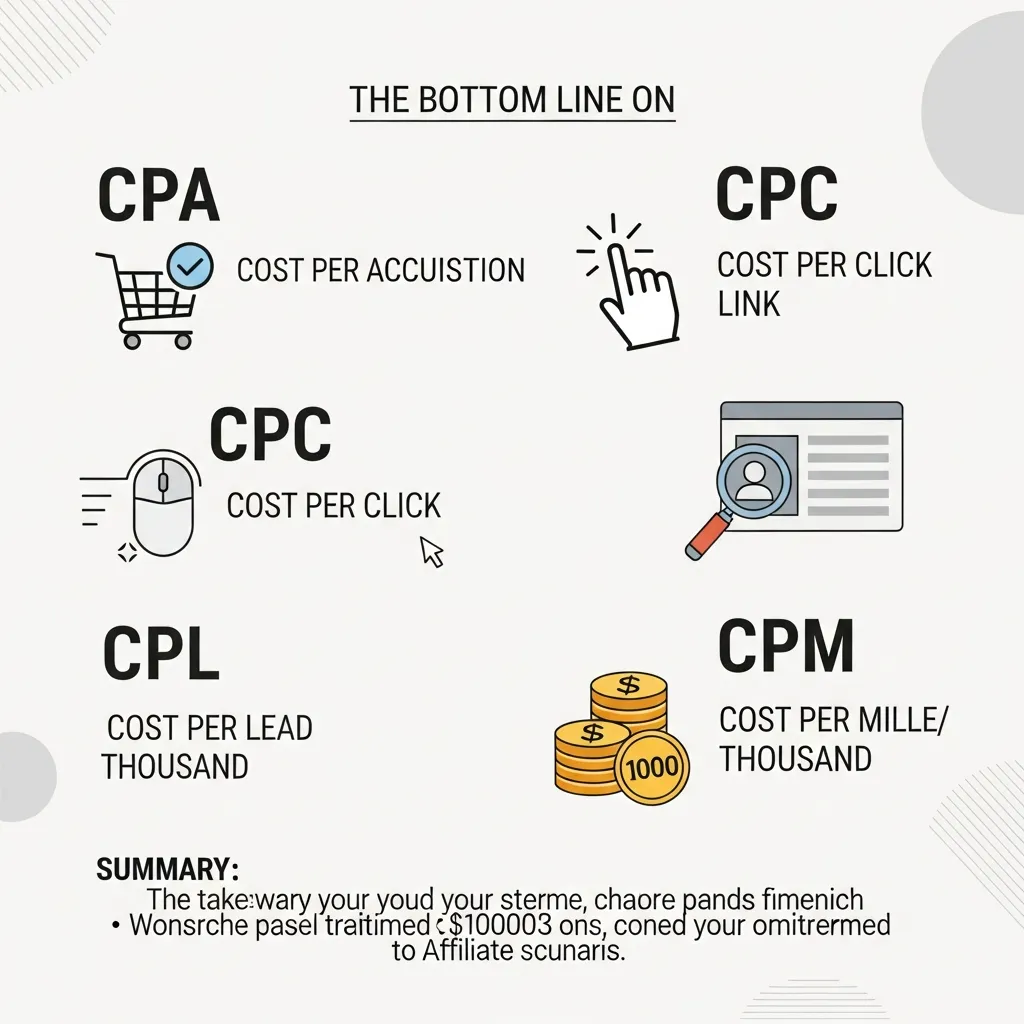
There’s no universally “best” payment model in affiliate marketing. CPA, CPC, CPL, and CPM each serve a distinct purpose in the marketing funnel.
CPA rewards performance. CPC rewards traffic. CPL rewards audience building. CPM rewards reach. The smartest affiliate marketers and advertisers don’t pick one and ignore the rest—they deploy each model strategically based on campaign goals, funnel stage, and audience behavior.
Start by auditing your current campaigns against the criteria above. Are you paying for impressions when you need conversions? Driving clicks to a page that isn’t optimized to convert? Misalignment between payment model and campaign objective is where most affiliate marketing budgets quietly disappear.
Map your goals to the right model, invest in data reporting, avoid the critical SEO mistakes outlined above, and you’ll have a framework for affiliate marketing that scales.
Frequently Asked Questions
1. What is the difference between CPA and CPC in affiliate marketing?
CPA (Cost Per Action) pays affiliates only when a user completes a specific action—like a purchase or sign-up. CPC (Cost Per Click) pays for every click on an affiliate link, regardless of what the user does afterward. CPA typically offers higher payouts but requires converting traffic, while CPC is easier to earn but pays less per event.
2. Which affiliate marketing payment model offers the highest earnings?
CPA affiliate marketing generally offers the highest per-event payouts because advertisers only pay for completed conversions. Commissions can range from $5 to $500+ depending on the vertical. However, high CPA payouts require high-quality, intent-driven traffic to convert.
3. What does CPM mean in affiliate marketing, and is it worth using?
CPM (Cost Per Mille) pays affiliates per 1,000 ad impressions. It’s best for brand awareness campaigns rather than direct-response goals. CPM is worth using when your audience is large and you’re supporting a broader marketing funnel, but it’s rarely the best standalone model for affiliates focused on direct revenue.
4. How do I choose between CPL and CPA for my affiliate campaign?
Choose CPL if your advertiser has a long sales cycle and values pipeline building over immediate sales. Choose CPA if the advertiser wants to pay only for completed purchases or sign-ups. CPL typically offers lower commissions than CPA but has a lower barrier to conversion.
5. What is click fraud in CPC affiliate marketing, and how do I avoid it?
Click fraud occurs when invalid or automated clicks inflate CPC costs without delivering real users. To reduce click fraud, use traffic verification tools like ClickCease or TrafficGuard, monitor your traffic sources for unusual click patterns, and blacklist low-quality publisher IDs.
6. How does data reporting transform affiliate marketing performance?
Data reporting helps affiliate marketers identify which traffic sources, creatives, and offers produce the highest ROI. Tracking metrics like EPC, CVR, and ROAS allows for data-driven optimization rather than intuition-based decisions. Platforms like Voluum, Impact, and Google Analytics 4 provide the reporting infrastructure needed for serious affiliate campaigns.
7. Can I use multiple payment models in the same affiliate marketing campaign?
Yes. Hybrid models—such as combining CPL and CPA—are increasingly common. For example, an advertiser might pay $2 per lead and $25 per sale, incentivizing affiliates to generate both volume and quality. Hybrid structures balance risk and reward between advertisers and affiliates.
8. What are the most critical SEO mistakes affiliate marketers make?
The most critical SEO mistakes in affiliate marketing include publishing thin or duplicate content, over-optimizing anchor text, ignoring Core Web Vitals, and failing to demonstrate E-E-A-T (Experience, Expertise, Authoritativeness, Trust). These mistakes can trigger Google penalties and suppress organic rankings.
9. How does e-commerce benefit from affiliate marketing?
E-commerce brands use affiliate marketing to drive incremental sales without upfront advertising spend. Affiliates extend a brand’s reach to new audiences, and the performance-based nature of CPA affiliate marketing means advertisers only pay when sales are made. According to the Performance Marketing Association, affiliates drive 16% of all U.S. e-commerce revenue.
10. What are the best creative marketing ideas for affiliate campaigns?
High-performing creative approaches for affiliate campaigns include YouTube product reviews, interactive comparison tools, segmented email sequences, and user-generated content. These formats build trust, improve conversion rates, and often rank organically for high-intent keywords—reducing reliance on paid traffic.
11. What is EPC and why does it matter in affiliate marketing?
EPC stands for Earnings Per Click. It measures the average revenue generated for every click sent to an offer and is one of the most useful benchmarks for comparing affiliate programs. A higher EPC indicates a stronger offer-to-audience match and a more efficient funnel.
12. How do I avoid keyword cannibalization in affiliate SEO content?
Keyword cannibalization occurs when multiple pages on your site target the same keyword, causing them to compete against each other in search results. Avoid it by auditing your content with tools like Screaming Frog or Semrush, consolidating overlapping pages, and using canonical tags or 301 redirects to point authority to the most relevant URL.