Online Store Development: Build Your Online Business

This comprehensive guide delivers an end-to-end framework for launching, optimizing, and scaling a high-converting digital storefront. You will explore platform selection criteria, UX/UI architecture, technical integration, conversion rate optimization, modern payment gateway security, and long-term organic search strategies designed to maximize revenue and market share for your online store.
The Evolution of E-Commerce and Digital Retail Architecture
The landscape of digital commerce has undergone a massive transformation over the past decade. Modern consumers demand instantaneous page loads, hyper-personalized product recommendations, seamless mobile checkout experiences, and omni-channel fulfillment options. To meet these elevated expectations, businesses must view their digital storefront not merely as a digital catalog, but as a complex software ecosystem that integrates inventory control, customer relationship management, payment processing, and logistics management.
When launching an online store, understanding the underlying technological framework is critical. Modern architecture relies heavily on cloud infrastructure, microservices, and headless capabilities that decouple the front-end presentation layer from the back-end transaction engine. This separation allows brands to update user interfaces dynamically without risking core transactional stability, ensuring that high-traffic flash sales or seasonal marketing campaigns execute flawlessly for your online store.
Furthermore, consumer purchasing behavior has shifted dramatically toward mobile-first and social-driven discovery. Every successful online store must be architected from the ground up to accommodate micro-interactions, single-tap checkout procedures, and responsive media rendering. Companies that invest in robust architecture establish a durable foundation capable of adapting to emerging technologies such as augmented reality product previews, voice-assisted search, and predictive automated inventory restocking algorithms.
Selecting the Right Development Platform for Your Business
Choosing the optimal base platform dictates your long-term technical debt, operational agility, customization potential, and overall cost of ownership. Different software frameworks cater to distinct business models, transaction volumes, catalog complexities, and internal technical capabilities. Evaluating these solutions requires balancing short-term deployment speed against long-term scalability and customization requirements.
SaaS Solutions vs. Open-Source Systems
Software-as-a-Service (SaaS) platforms like Shopify, Big Commerce, and Salesforce Commerce Cloud offer managed hosting, built-in security compliance, automatic software updates, and rapid deployment cycles. These platforms are ideal for brands prioritizing speed-to-market and low infrastructure management overhead when setting up an online store. However, SaaS platforms often impose operational boundaries through rigid template structures, monthly app transaction fees, and limited backend database modifications.
Conversely, open-source architectures such as Woo Commerce, Magento (Adobe Commerce), and Shopware grant complete ownership over your codebase, database structures, and server deployment configurations. Open-source systems enable limitless bespoke feature customization, advanced third-party integrations, and complex B2B workflow designs for any growing online store. The trade-off involves higher maintenance costs, required dedicated engineering resources, manual security patching, and complex hosting infrastructure management.
| Feature / Criteria | SaaS Platforms (e.g., Shopify, BigCommerce) | Open-Source Systems (e.g., WooCommerce, Magento) | Headless / Custom Architectures |
| Time to Market | Extremely Fast (Days to Weeks) | Moderate (Weeks to Months) | Lengthy (Months of Custom Engineering) |
| Technical Overhead | Very Low (Managed Infrastructure) | High (Requires Devops & Sysadmins) | Very High (Bespoke API & Frontend Management) |
| Customization Flexibility | Restricted to App Ecosystems & APIs | Complete Control Over Source Code | Infinite Control Across Every Touchpoint |
| Security & Compliance | Included (PCI-DSS Level 1 Handled) | Manual Configuration & Patching Required | Custom Security Architecture Required |
| Scalability Costs | Variable (App Fees + Plan Upgrades) | Server Costs + Maintenance Overhead | High Initial Investment, Efficient at Scale |
Decoupled and Headless Commerce Architectures
For rapidly scaling enterprise brands, traditional monolithic platforms—where front-end templates are tightly coupled to back-end databases—can introduce performance bottlenecks. Headless commerce decouples the front-end display layer (built using frameworks like Next.js, React, or Vue.js) from the back-end engine via RESTful or GraphQL APIs. This strategy allows developers to build lightning-fast web interfaces for your online store, deploy content across multiple digital touchpoints (such as mobile apps, IoT devices, and smart displays), and maintain absolute control over web page performance and user experience design.
When choosing your technical foundation, evaluate your total cost of ownership over a three-to-five-year horizon. Factor in platform licensing fees, custom development hours, payment processing markups, third-party plugin subscription costs, cloud hosting maintenance, and ongoing security audits. Aligning your choice with your internal team’s technical acumen ensures your platform supports long-term revenue growth without creating unexpected technical bottlenecks.
Essential Steps in the Online Store Development Lifecycle
Building a enterprise-ready digital commerce platform demands a structured development lifecycle. Skipping foundational planning stages to rush toward visual design frequently results in misaligned user flows, database bottlenecks, inadequate security measures, and costly post-launch rework. A systematic approach ensures all stakeholder requirements, customer expectations, and technical dependencies are addressed sequentially for your online store.
Discovery, Technical Architecture, and Wireframing
The discovery phase defines target audience personas, maps out primary conversion funnels, establishes technical integration requirements, and designs wireframes for key site templates. Wireframes serve as the structural layout blueprints for the homepage, category pages, product detail pages (PDPs), cart drawers, and multi-step checkout processes before visual branding is applied.
During technical planning, map out every external API connection needed for operation. This includes Enterprise Resource Planning (ERP) systems, Customer Relationship Management (CRM) suites, Warehouse Management Software (WMS), tax automation tools, and email marketing platforms. Documenting data sync frequencies, payload formats, and error-handling protocols early prevents system sync failures once sales operations go live.
Front-End Development and Visual Design Systems
Front-end development transforms visual mockups into clean, semantic HTML5, CSS3, and JavaScript code. Establishing a robust design system ensures visual consistency across every customer touchpoint while keeping stylesheets lightweight and maintainable. Modern front-end development emphasizes responsive grid layouts, optimized CSS delivery, vector graphics, and accessible contrast ratios that comply with WCAG 2.1 AA standards.
Focus heavily on micro-interactions and performance optimization during front-end construction. Implement lazy-loading for off-screen images, utilize modern web fonts with optimized fallback stacks, minimize cumulative layout shifts (CLS), and enforce strict script execution orders. A responsive, visually engaging, and ultra-fast front end builds trust with consumers and reduces initial bounce rates across all acquisition channels.
Back-End Configuration, Data Migration, and Deployment
Back-end engineering involves configuring database structures, business logic rules, shipping rate matrices, payment gateway rules, and third-party integrations. If migrating from a legacy store, execute catalog and customer data migration with extreme precision. Sanitize product SKUs, re-map custom product attributes, preserve customer purchase histories, and securely import encrypted password hashes or trigger password reset workflows.
Before launching your online store, execute thorough end-to-end quality assurance testing. Conduct load testing to verify server performance under extreme traffic spikes, perform cross-browser and cross-device display checks, validate payment processing workflows in live staging environments, and verify 301 redirect maps for every legacy URL to preserve organic search authority. Once all staging parameters pass security and performance audits, execute the DNS switchover and launch your new platform.
Designing High-Converting User Experiences (UX/UI)
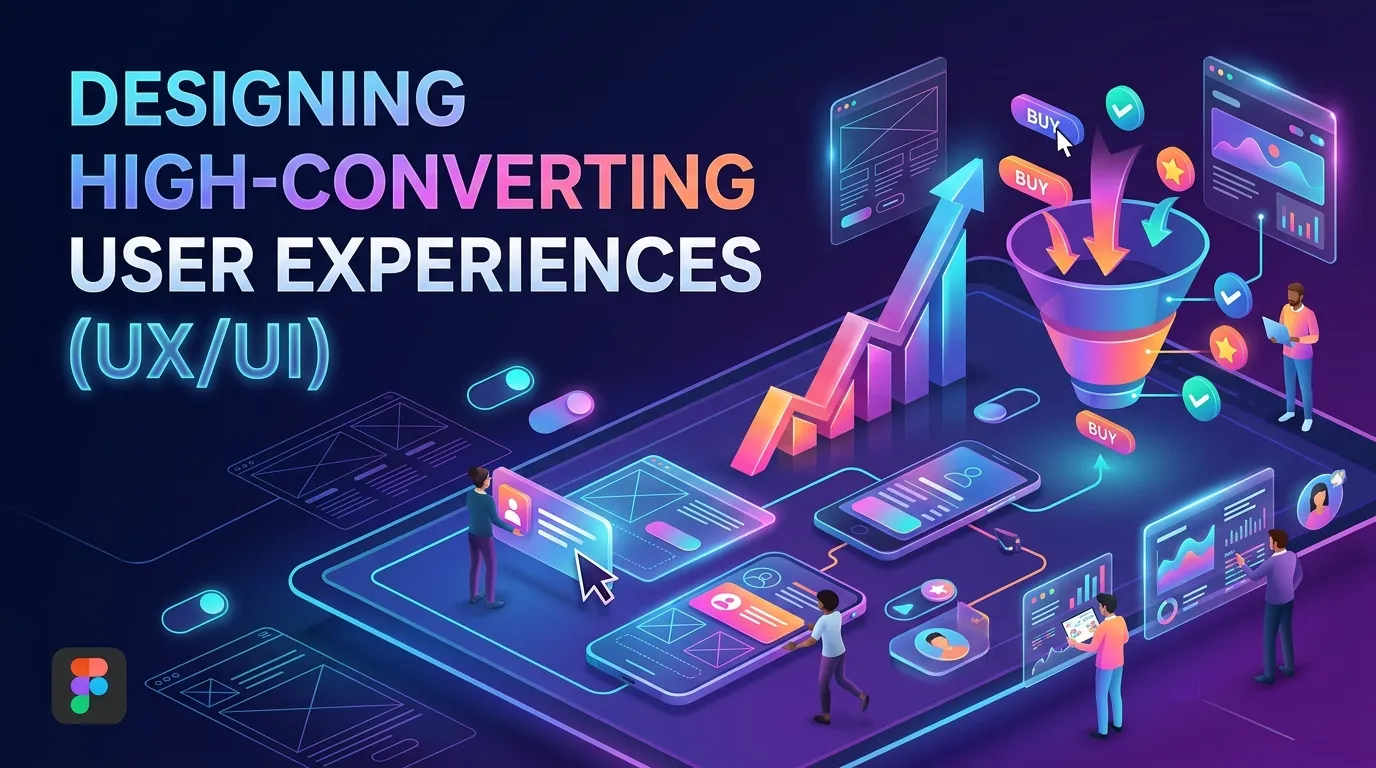 User experience design directly dictates conversion efficiency and customer acquisition costs. A beautifully designed platform that confuses users, loads slowly, or buries critical product specifications will underperform compared to a streamlined, fast, and intuitive store. Designing for conversion requires eliminating friction, establishing immediate visual clarity, and guiding visitors seamlessly toward checkout completion in your online store.
Mobile-First Navigation and Visual Hierarchy
With mobile devices driving over 60% of total digital commerce traffic globally, web interfaces must be conceptualized for smartphone displays first. Navigation menus must be concise, utilizing sticky headers, expandable accordion categories, and persistent slide-out shopping carts. Primary action buttons—such as “Add to Cart” and “Proceed to Checkout”—should sit comfortably within thumb reach on mobile screens.
Visual hierarchy directs user attention to essential elements using strategic typography scale, contrast, white space, and accent colors. Ensure product pricing, dynamic shipping promotions, and customer review scores are clear upon page load. Minimize visual clutter on Product Detail Pages (PDPs) by organizing secondary specifications, sizing guides, and care instructions within collapsible tabs or progressive disclosure accordions.
Streamlining the Checkout Funnel and Reducing Abandonment
Checkout friction remains the leading cause of cart abandonment across digital commerce platforms. To maximize completed transactions, eliminate mandatory account creation requirements by offering a streamlined guest checkout option. Integrate express payment wallets such as Apple Pay, Google Pay, Shop Pay, and PayPal Express that auto-fill shipping addresses and payment details with single-tap biometric authentication.
Address unexpected costs early in the buying flow by displaying transparent shipping calculators and dynamic tax estimations directly within the cart drawer. Incorporate visual trust badges—such as SSL encryption verification, money-back guarantees, accepted payment method icons, and clear return policy links—adjacent to checkout action buttons. Reducing checkout form fields to the absolute minimum necessary for address verification and order fulfillment significantly increases conversion rates across all traffic channels for your online store.
Technical SEO and Content Optimization for E-Commerce
Search engine optimization is vital for acquiring zero-cost, high-intent traffic over time. E-commerce platforms face unique technical SEO challenges due to massive URL counts, dynamic faceted navigation filters, duplicate content generated by color/size variations, and out-of-stock product pages. Addressing these technical parameters ensures search engines crawl, index, and rank your product catalog efficiently for any online store.
Information Architecture and Faceted Navigation Management
Organize your platform using a logical visual hierarchy that limits any product page depth to no more than three clicks from the homepage. A clean category structure allows search engine crawlers to pass page authority across your site hierarchy while helping users locate products effortlessly.
Faceted navigation—which allows shoppers to filter products by size, color, brand, price, and material—can quickly generate thousands of duplicate or low-value URLs that consume search engine crawl budget. Manage faceted navigation by implementing canonical tags pointing back to the main category URL, applying rel="nofollow" attributes to non-essential filter parameters, or using AJAX-based filtering systems that update product grids without creating indexable URL parameters.
Schema Markup and Rich Snippet Implementation
Structured data markup using Schema.org vocabulary communicates product catalog details directly to search engines. Implementing structured data enables your listings to stand out in Google Search results with rich snippets, displaying visual rating stars, product pricing, real-time stock availability, delivery estimates, and review counts for your online store.
Alongside structured data, write unique, benefit-focused product descriptions that avoid vendor-provided boilerplate text. Integrate strategic long-tail semantic terms while maintaining a compelling brand voice. Build educational blog content that addresses top-of-funnel customer questions, buying guides, and product comparisons to capture early-stage research traffic and guide readers into your sales funnel via strategic Seasonal Marketing Strategies.
Security, Payment Processing, and Data Protection
Building a high-performing digital business requires robust cyber security defenses, payment processing compliance, and international data protection standards. Online retail operations are primary targets for automated credential stuffing, distributed denial-of-service (DDoS) attacks, credit card testing, and customer data exfiltration. Establishing strict security protocols protects your brand’s reputation and shields your enterprise from catastrophic legal liabilities in your online store.
PCI-DSS Compliance and Payment Gateway Integration
Any digital platform handling credit card transactions must comply strictly with the Payment Card Industry Data Security Standard (PCI-DSS). Achieving Level 1 PCI compliance requires implementing end-to-end encryption, network firewalls, strict access controls, and recurring vulnerability scans. To minimize internal compliance burdens, leverage hosted payment fields, tokenization APIs, or iframe-based gateways provided by established processors like Stripe, Adyen, or PayPal Braintree.
Tokenization ensures sensitive card details never touch or reside on your application servers. Instead, payment details are transmitted directly to the secure vault of the processor, which returns a unique tokenized string used by your system to execute charges, issue refunds, or process recurring subscriptions. This strategy keeps your web servers out of PCI scope while ensuring seamless processing for your online store.
Data Privacy Laws and Fraud Mitigation Frameworks
Compliance with international privacy frameworks—such as the General Data Protection Regulation (GDPR) in Europe and the California Consumer Privacy Act (CCPA)—is non-negotiable. Implement transparent cookie consent systems, offer clear opt-out choices for data tracking, securely store customer personal information using AES-256 encryption, and maintain documented procedures for handling customer data deletion requests.
Deploy automated AI fraud detection software (such as Sift, Signifyd, or Kount) to evaluate transaction risk in real time. These tools analyze device fingerprinting, IP address locations, behavioral metrics, and global historical chargeback databases to instantly approve legitimate purchases while flagging or blocking high-risk transactions. Balancing aggressive fraud prevention with low false-positive rates protects your profit margins without alienating legitimate buyers.
Integrating Logistics, ERP, and Inventory Management Systems
 Operational excellence in digital retail relies on real-time synchronization between front-end order portals and back-end fulfillment networks. Without robust system integrations, businesses risk overselling out-of-stock items, shipping delays, high customer support costs, and inaccurate inventory accounting. Connecting your storefront to an Enterprise Resource Planning (ERP) platform creates an automated operational pipeline for your online store.
Centralized Multi-Channel Inventory Synchronization
When selling across multiple platforms—such as your main website, Amazon, eBay, and social commerce channels—centralized inventory management is mandatory. Systems like NetSuite, SAP, or specialized middleware automatically sync stock levels every time a sale occurs on any channel. This real-time inventory allocation prevents overselling, automatically updates safety stock buffers, and triggers purchase orders with raw material suppliers or third-party logistics (3PL) providers when stock hits reorder thresholds.
Furthermore, integrating advanced shipping software (such as ShipStation, EasyPost, or Shippo) automates carrier rate shopping across FedEx, UPS, DHL, and local postal services. Automated label generation, custom packing slip printing, and real-time package tracking link creation streamline warehouse operations and allow small fulfillment teams to process thousands of daily shipments error-free.
Managing Returns and Reverse Logistics Infrastructure
A smooth return process builds customer trust and encourages initial purchases. Integrating automated customer return portals—such as Loop Returns, Happy Returns, or Narvar—allows customers to initiate returns, print prepaid shipping labels, or select store credit exchanges independently without contacting support agents.
An efficient reverse logistics workflow automatically updates warehouse stock ledgers, tracks return reasons, inspects returned items for quality control, and processes refunds or exchanges seamlessly. Analyzing return data helps identify product quality issues, sizing discrepancies, or inaccurate PDP descriptions early, allowing product teams to fix underlying product issues before they damage brand reputation.
Advanced Optimization: Conversion Rate Optimization (CRO) and Scaling
Launching your platform is merely the beginning of the digital retail lifecycle. Continuous growth requires data-driven optimization designed to improve conversion rates, increase Average Order Value (AOV), and boost Customer Lifetime Value (LTV). Implementing systematic experimentation frameworks transforms existing traffic into significantly higher bottom-line revenue for your online store.
A/B Testing, Heatmaps, and User Analytics
Continuous experimentation relies on combining quantitative data with qualitative behavioral insights. Analytics platforms (such as Google Analytics 4, Mixpanel, and Amplitude) track core funnel drop-off points, revenue attribution models, and visitor conversion paths. Complement this data with behavioral tools like Hotjar or Microsoft Clarity to view session recordings, scroll depth heatmaps, and click maps that reveal exactly where users experience hesitation or usability barriers.
Run structured A/B and multivariate tests using platforms like VWO, Optimizely, or Kameleoon. Test critical page elements including:
-
Main hero value propositions and headline messaging.
-
Primary call-to-action button colors, placements, and microcopy.
-
Layout configurations of Product Detail Pages (PDPs), including gallery image formats vs. product videos.
-
Cart drawer upsell recommendations and free-shipping progress bars.
-
Multi-step vs. single-page checkout structures.
Testing hypothesis-driven variations systematically allows brands to validate changes empirically, preventing costly site updates based on subjective opinions.
Maximizing Average Order Value (AOV) and Lifetime Value (LTV)
Increasing Average Order Value (AOV) is one of the most effective levers for improving acquisition profitability. Implement automated cross-selling and upselling modules powered by AI recommendation algorithms (such as Nosto, Rebuy, or Searchspring). These engines display dynamic “Frequently Bought Together” bundles, personalized product recommendations on PDPs, and last-minute add-ons inside the cart drawer based on historical purchasing behaviors.
To boost long-term Customer Lifetime Value (LTV), deploy sophisticated automated lifecycle marketing strategies. Integrate email and SMS marketing platforms (like Klaviyo or Attentive) to trigger behavior-based flows, retention campaigns, and VIP loyalty tiers that reward repeat purchases and continuous brand engagement. Building strong, direct connections with existing customers reduces reliance on increasingly expensive paid acquisition channels.
For businesses looking to build sustainable brand equity and establish long-term digital authority, applying comprehensive Seasonal Branding strategies helps optimize promotional campaign calendars, refresh visual marketing assets, and structure high-converting sales events throughout the operational year.
Expert Pro Tips for E-Commerce Success
Navigating modern digital retail requires operational agility, technical expertise, and obsessive focus on customer satisfaction. Incorporating these expert recommendations will help safeguard your technology investment and accelerate long-term revenue growth for your online store:
- Prioritize Site Speed Above All Else. Every single second of load delay reduces conversions by up to 7%. Optimize image compression using modern Next-Gen formats like WebP or AVIF, deploy global Content Delivery Networks (CDNs) like Cloudflare or Fastly, and aggressively audit third-party tracking scripts to keep server response times well under 200 milliseconds.
- Treat Search Functionality as a High-Intent Sales Tool. Site search users convert at up to three times the rate of casual browsers. Implement advanced AI-driven search software (such as Algolia, Coveo, or Searchspring) that offers auto-suggest preview cards, tolerates misspellings, supports natural language search queries, and dynamically prioritizes high-margin products within search results.
- Leverage Dynamic Social Proof. Static star ratings are no longer enough. Integrate user-generated content (UGC) platforms like Yotpo, Okendo, or Bazaarvoice to pull real customer photos, video reviews, verified buyer badges, and searchable customer Q&A sections directly into your PDP layouts to alleviate purchase anxiety.
- Plan for Peak Traffic Events Early. Never wait until Black Friday to test server load capabilities. Conduct stress tests at three to five times your historical peak traffic volume, establish API rate-limiting safeguards, simplify non-essential scripts during peak sales, and create emergency static landing page fallbacks to ensure uninterrupted checkout functionality during massive promotional events.
Common Mistakes to Avoid in E-Commerce Development
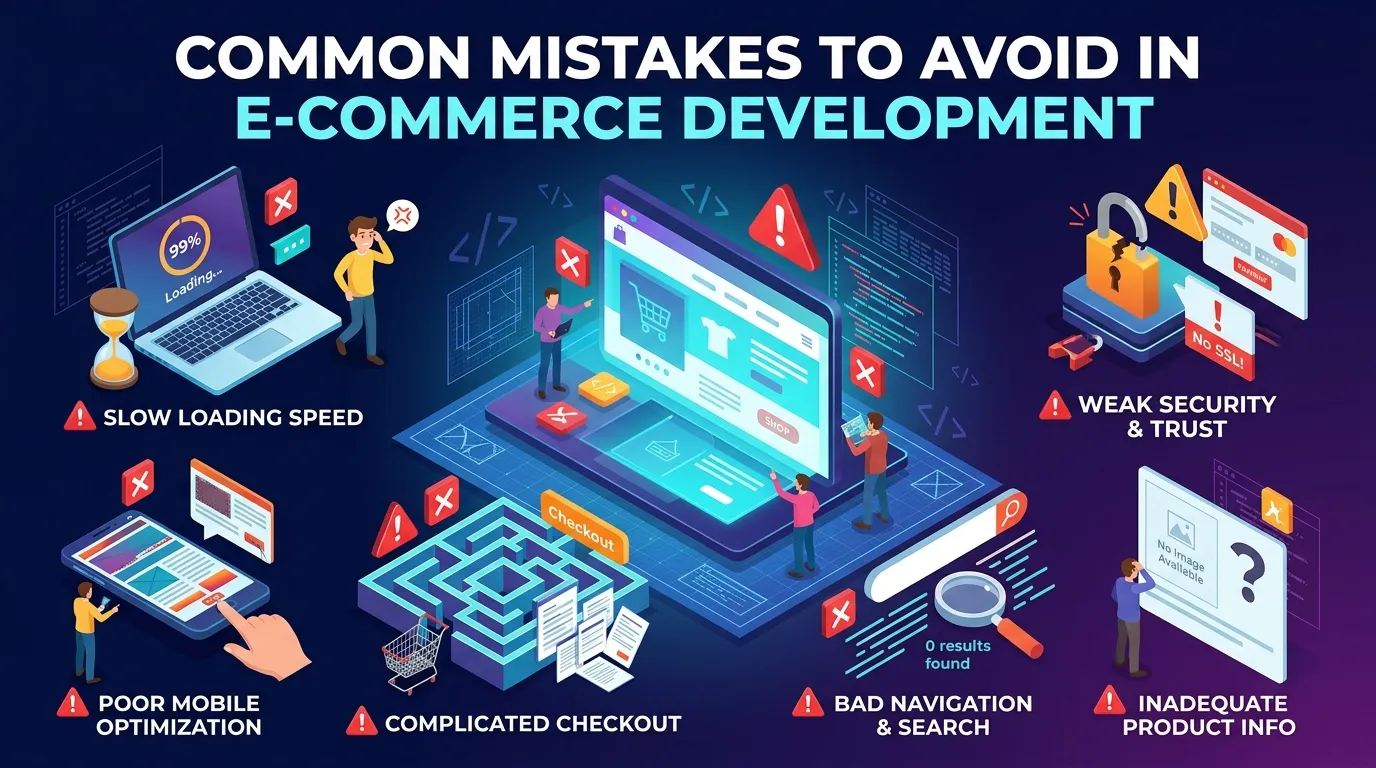 Building an enterprise platform presents numerous strategic and technical pitfalls. Steering clear of these frequent mistakes will save hundreds of development hours and prevent significant lost revenue:
-
Over-Customizing Core Platform Features: Attempting to rewrite standard platform code structures creates immense technical debt, makes security upgrades difficult, and breaks third-party app compatibility. Rely on native features or established API modules whenever possible.
-
Ignoring Mobile Checkout Friction: Designing site layouts on high-resolution desktop monitors often leads teams to overlook cramped mobile checkout forms, slow-loading mobile assets, and tiny mobile tap targets that destroy mobile conversion rates.
-
Neglecting Post-Launch Infrastructure Budgets: Allocating 100% of your digital budget purely to launch-day design and development leaves zero resources for ongoing server maintenance, security monitoring, A/B testing, CRO software subscriptions, and iterative feature development.
-
Failing to Establish Clear Product Data Standards: Inconsistent product title naming conventions, missing SKU formats, incomplete category taxonomy structures, and missing attribute data severely compromise site search accuracy, faceted navigation filters, and automated Google Shopping feeds.
-
Underestimating Customer Service Automation: Launching a storefront without live chat, interactive self-service order lookup tools, or structured FAQ frameworks quickly overwhelms support staff with simple transactional inquiries, leading to delayed response times and negative customer reviews.
Executing a successful platform strategy requires balancing cutting-edge technology, user-centered design, operational infrastructure, and data-driven marketing. To understand how to align your product development cycles with peak consumer demand periods throughout the business calendar, explore our detailed guide on Seasonal Content Marketing.
Building a world-class digital business demands continuous iteration, strategic planning, and unwavering commitment to customer value. By deploying resilient architecture, focusing relentlessly on user experience, securing transaction pipelines, and scaling through data-backed optimization, your organization can establish a highly profitable, scalable, and durable online store.
Conclusion
Building a successful online store requires balancing modern architecture, intuitive user experiences, bulletproof security, and continuous conversion optimization. By following this end-to-end framework, your business can scale efficiently, maximize revenue, and outpace market competitors. Are you ready to launch your high-converting digital storefront? Partner with our expert development team today to build your enterprise platform.
FAQ
1. How much does it cost to complete an Online Store development project?
Costs vary based on platform selection, design complexity, and integration requirements. Basic SaaS setups utilizing pre-built templates range from $3,000 to $10,000. Mid-market custom SaaS or open-source builds typically cost between $25,000 and $80,000. Enterprise-level headless custom builds featuring deep ERP, WMS, and CRM integrations range from $100,000 to over $300,000.
2. How long does it take to launch a fully custom digital storefront?
A standard templated SaaS store can launch within 2 to 4 weeks. Custom-designed SaaS or WooCommerce sites require 8 to 14 weeks for development, testing, and migration. Complex enterprise setups, open-source builds, or headless architectures take 4 to 9 months, depending on integration scopes and database migration parameters.
3. Which e-commerce platform is best for a growing business?
Shopify and BigCommerce are ideal for brands seeking rapid growth, managed security, and low technical overhead. WooCommerce offers budget-friendly flexibility for WordPress setups. Magento (Adobe Commerce) and custom Headless systems best serve large enterprise businesses requiring total code ownership, complex B2B features, and bespoke customization.
4. How can I improve my website’s mobile conversion rates?
Streamline mobile checkout by integrating express wallets (Apple Pay, Google Pay, Shop Pay), using sticky “Add to Cart” buttons, eliminating mandatory account creation, compressing page images to improve load times, and ensuring all buttons and form fields are easily tap-friendly.
5. What are the best methods for securing a web storefront against cyber threats?
Enforce HTTPS/TLS encryption across all pages, utilize PCI-DSS compliant payment gateways with tokenization, implement Web Application Firewalls (WAF) like Cloudflare, require two-factor authentication (2FA) for admin access, run regular vulnerability scans, and maintain strict, real-time database backup routines.
6. What is headless commerce and should my business adopt it?
Headless commerce decouples the front-end user interface from the back-end commerce engine via APIs. Adopt headless commerce if you require ultra-fast web performance, bespoke user interface design flexibility, or multi-channel content delivery across web, mobile apps, and IoT devices.
7. How do I prevent cart abandonment during the checkout process?
Offer guest checkout options, display clear shipping costs and taxes early in the cart funnel, provide multiple secure payment choices, display security trust badges, streamline checkout form fields, and deploy automated cart recovery emails and SMS messages.
8. Why is structured data (Schema markup) important for product pages?
Structured data helps search engines understand product details like price, availability, aggregate star ratings, and review counts. This allows search engines to display rich snippets in search results, increasing search visibility and click-through rates (CTR).
9. How do I seamlessly integrate an ERP system with my digital sales platform?
Use robust API integrations or dedicated middleware solutions (such as Celigo, Jitterbit, or custom webhooks) to establish real-time, bi-directional data synchronization between your storefront and ERP system for orders, inventory levels, customer records, and fulfillment tracking.
10. What metrics should I track to measure e-commerce performance?
Key performance indicators (KPIs) to track continuously include Conversion Rate (CR), Average Order Value (AOV), Customer Acquisition Cost (CAC), Customer Lifetime Value (LTV), Cart Abandonment Rate, Return on Ad Spend (ROAS), and Net Promoter Score (NPS).