E-commerce SEO: Complete Strategy to Boost Online Store
E-commerce SEO is the process of optimizing an online store, product pages, category pages, content, and technical elements to improve visibility in search engines and attract qualified shoppers. A successful e-commerce SEO strategy combines keyword research, search-friendly site architecture, product page optimization, technical SEO, internal linking, content marketing, structured data, user experience, and continuous performance tracking. This guide explains how to build an effective e-commerce SEO strategy that can increase organic traffic, improve product visibility, and generate more sales.
What Is E-commerce SEO?
E-commerce SEO is the practice of optimizing an online store so that its products, categories, and other valuable pages can appear more prominently in organic search results.
Unlike traditional SEO, e-commerce SEO has to address a large number of product and category URLs. An online store may have hundreds or thousands of pages, including:
- Product pages
- Category pages
- Subcategory pages
- Brand pages
- Collection pages
- Buying guides
- Blog posts
- Product variations
- Search and filter pages
The goal is not simply to generate more website traffic. The objective is to attract people who are actively searching for products, categories, solutions, or information related to what the store sells.
For example, someone searching for “wireless noise cancelling headphones” has a different search intent from someone searching for “what are noise cancelling headphones.” An effective SEO strategy understands these differences and creates the appropriate page for each intent.
Why Is E-commerce SEO Important?
Search engines can be an important discovery channel for online stores because shoppers frequently research products, compare alternatives, evaluate features, and look for specific brands before making a purchase.
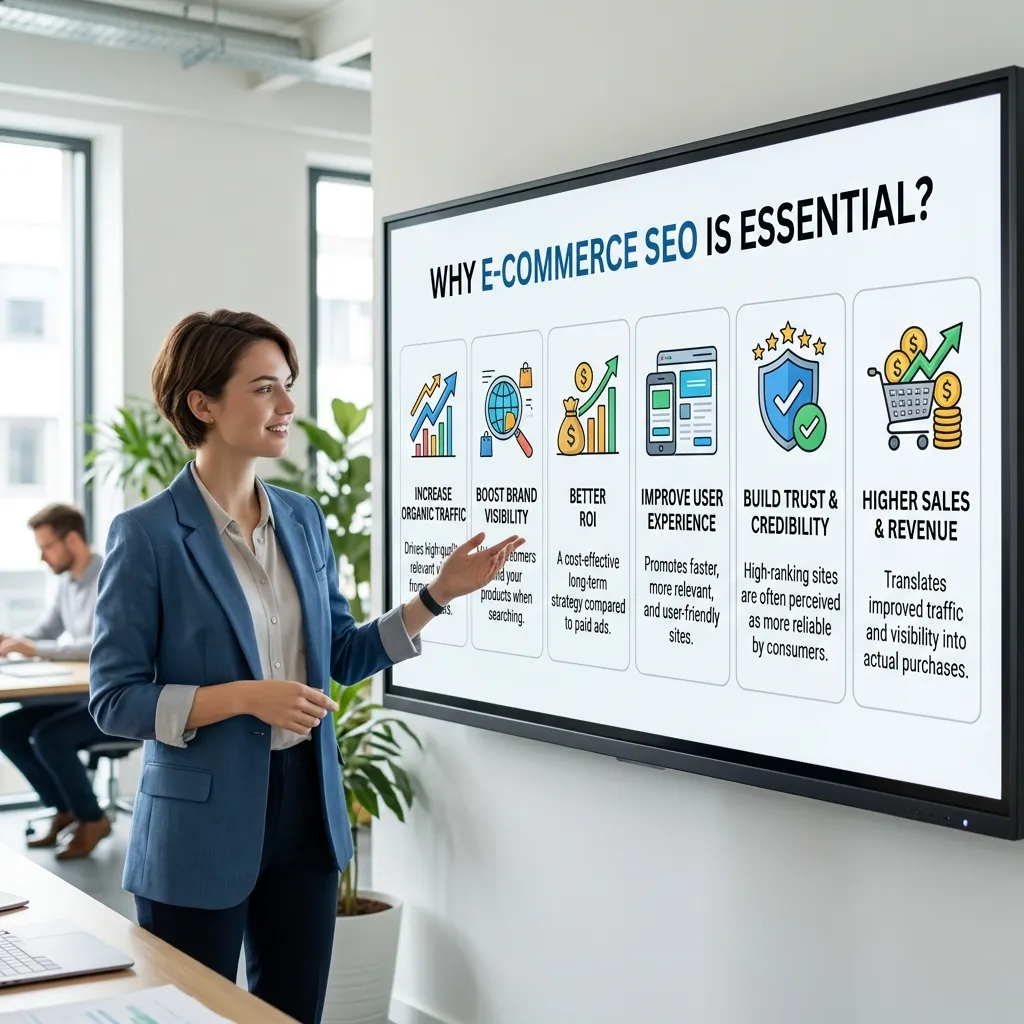
A strong e-commerce SEO strategy can help a store:
- Increase organic visibility
- Attract targeted visitors
- Reduce dependence on paid advertising
- Improve product discovery
- Build long-term search traffic
- Reach shoppers at different stages of the buying journey
- Increase qualified leads and sales
- Strengthen brand authority
- Improve the overall website experience
SEO can also support other marketing channels. For example, content discovered through organic search can support email campaigns, social media, remarketing, and customer education.
For stores that want a broader understanding of their digital strategy, this e-commerce marketing guide provides additional context on how SEO fits within online marketing.
E-commerce SEO vs Traditional SEO
The fundamental principles of SEO remain similar, but e-commerce websites have several additional challenges.
| Traditional SEO | E-commerce SEO |
|---|---|
| Focuses heavily on informational content | Focuses on products, categories, and commercial content |
| Usually has fewer important URLs | Can have hundreds or thousands of URLs |
| Content may be the primary asset | Product and category pages are critical |
| Conversion may not be the main goal | Revenue and transactions are major goals |
| Fewer product variations | Variants can create complex URL structures |
| Internal linking is relatively simple | Navigation and product relationships can be complex |
This means e-commerce SEO requires both search optimization and commerce-focused website architecture.
How to Build an E-commerce SEO Strategy
A successful strategy should not begin by randomly adding keywords to product descriptions. Start with research, structure, and technical foundations.
1. Define Your SEO Goals
Before making changes, determine what you want SEO to achieve.
Possible goals include:
- Increase organic product traffic
- Rank category pages for commercial keywords
- Increase non-branded search visibility
- Improve organic conversion rates
- Increase revenue from organic search
- Reduce paid acquisition dependence
- Improve visibility for high-margin products
Your goals should influence which keywords, pages, and metrics you prioritize.
For example, a store selling furniture may prioritize category-level terms such as “modern office desks,” while a specialty store may focus heavily on product-specific searches.
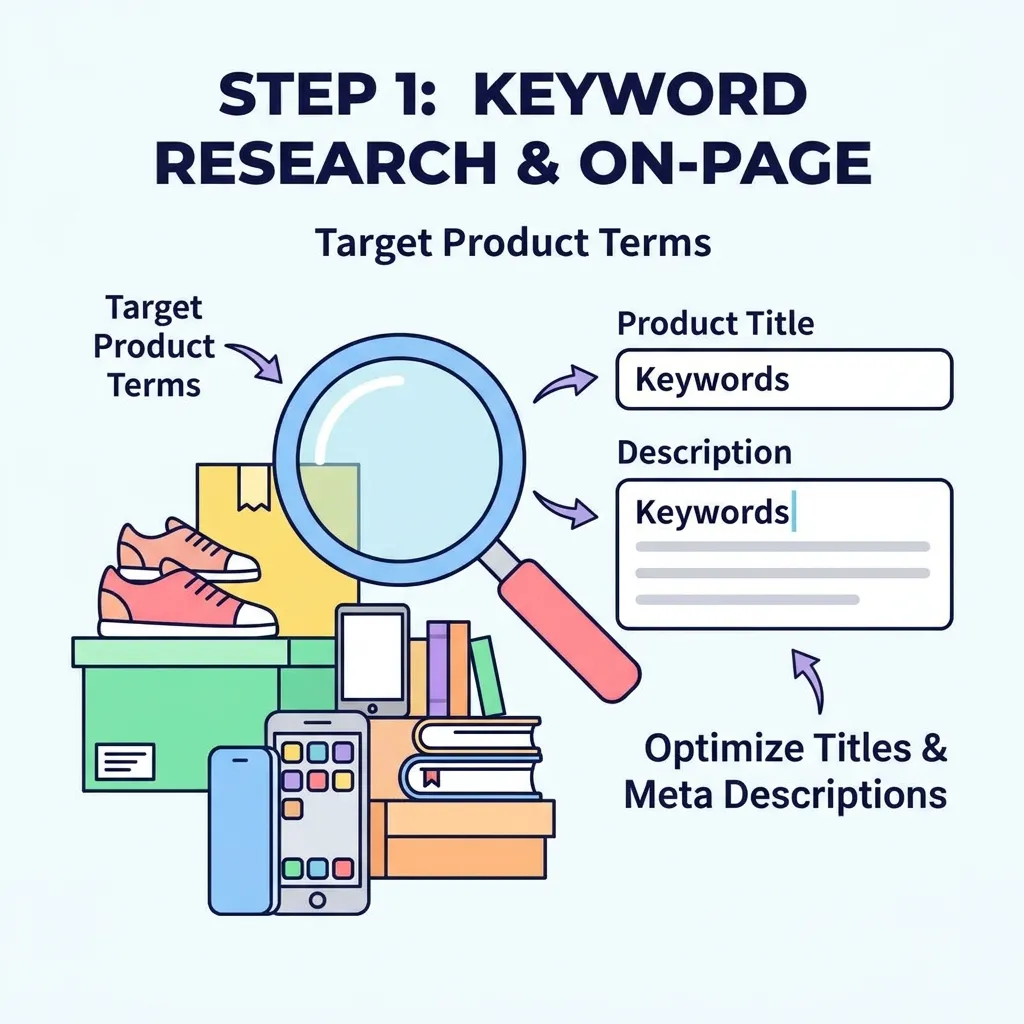
2. Perform E-commerce Keyword Research
Keyword research is the foundation of an effective e-commerce SEO strategy.
Instead of focusing only on high-volume keywords, identify terms that reflect different stages of customer intent.
Informational Keywords
These searches indicate that users want to learn something.
Examples:
- How to choose running shoes
- Best material for winter jackets
- How does a standing desk work?
These keywords are often useful for blog posts and buying guides.
Commercial Investigation Keywords
Users are researching products before purchasing.
Examples:
- Best running shoes for beginners
- Best standing desks
- Leather vs fabric office chairs
These searches can be targeted through comparison articles, buying guides, and category content.
Transactional Keywords
Users are closer to making a purchase.
Examples:
- Buy running shoes online
- Women’s waterproof hiking boots
- Wireless headphones price
Product and category pages are often appropriate targets.
Navigational Keywords
Users are looking for a particular brand, product, or store.
Examples:
- Nike running shoes
- Samsung Galaxy accessories
- Brand-name store
Understanding search intent prevents you from trying to rank the wrong type of page for a keyword.
3. Build a Logical Site Architecture
Site architecture is particularly important for e-commerce websites.
A search engine and a customer should be able to understand how your website is organized.
A simple structure might look like:
Homepage → Category → Subcategory → Product
For example:
Homepage → Shoes → Running Shoes → Men’s Running Shoes → Product
This structure helps users navigate the store and creates logical relationships between related pages.
Keep Important Pages Close to the Homepage
Important products and categories should not be buried deep within the website.
Use:
- Main navigation
- Category menus
- Breadcrumbs
- Related product links
- Related category links
- Contextual internal links
- HTML links where appropriate
A well-organized architecture can also make crawling and indexing easier.
4. Optimize Product Pages
Product pages are among the most valuable assets on an e-commerce website.
A well-optimized product page should provide enough information for both search engines and shoppers.
Optimize Product Titles
Create descriptive, specific product titles.
Instead of:
Running Shoes
Use:
Men’s Lightweight Running Shoes for Road Running
The exact format depends on the product and search behavior, but clarity should always come first.
Write Original Product Descriptions
Avoid copying descriptions supplied by manufacturers whenever possible.
A strong description should explain:
- What the product is
- Who it is for
- Main benefits
- Important features
- Materials
- Size information
- Compatibility
- Usage instructions
- Shipping or return information where relevant
The description should answer the questions a potential buyer is likely to have.
Optimize Product Images
Use high-quality images that clearly show the product.
Consider:
- Descriptive image filenames
- Useful alt text
- Multiple product angles
- Appropriate image compression
- Mobile-friendly image sizes
- Product-in-use images when relevant
Images can support both user experience and search visibility.
Add Useful Product Information
Depending on the product, include:
- Price
- Availability
- Brand
- Model
- SKU
- Dimensions
- Color
- Size
- Material
- Specifications
- Reviews
- Shipping details
- Return information
Accurate information helps customers make informed purchasing decisions.
5. Optimize Category Pages
Category pages are often overlooked, but they can be powerful organic landing pages.
For example, instead of optimizing only individual products for “running shoes,” create a strong category page targeting the broader commercial topic.
A useful category page may contain:
- Clear category title
- Short introductory copy
- Relevant products
- Helpful filters
- Descriptive subcategories
- Internal links
- FAQs when appropriate
- Buying guidance
- Useful category-specific information
Avoid filling category pages with unnecessary text simply to increase word count. The content should help shoppers understand the category and choose the right products.
6. Create SEO-Friendly URLs
Keep important ecommerce URLs simple and descriptive.
For example:
Good:
/mens-running-shoes/
Less useful:
/category.php?id=47382&product=9281
Clean URLs can make pages easier for users and search engines to understand.
Avoid creating unnecessary URL variations for every filter, sort option, or parameter.
7. Manage Product Variants Carefully
E-commerce stores often have products with multiple:
- Sizes
- Colors
- Materials
- Models
- Styles
- Configurations
For example, one shirt may be available in five colors and six sizes.
If every variation generates a separate URL without a clear SEO purpose, the site can accumulate many near-duplicate pages.
Google’s current documentation includes specific support for product variants and distinct URLs for product variants where appropriate.
Decide carefully which variations deserve indexable URLs and which should remain controlled through the main product page.
8. Improve Internal Linking
Internal links help shoppers discover related products and help search engines understand relationships between pages.
Useful internal linking opportunities include:
- Category → subcategory
- Category → product
- Product → related product
- Product → related category
- Blog → product
- Blog → category
- Buying guide → product
- Buying guide → category
For example, a blog post about choosing hiking boots could link naturally to a hiking boot category.
You can also strengthen your broader strategy with the site’s ecommerce SEO checklist when reviewing technical and on-page elements.
9. Create Helpful E-commerce Content
Product pages alone may not cover every search query your potential customers use.
Content marketing can capture informational and commercial searches that occur before the purchase.
Useful content formats include:
Buying Guides
Examples:
- How to Choose the Right Laptop
- How to Choose Running Shoes
- Complete Guide to Buying Office Furniture
Product Comparisons
Examples:
- Leather vs Fabric Office Chairs
- Wireless vs Wired Headphones
- Laptop A vs Laptop B
Educational Content
Examples:
- How to Maintain Leather Shoes
- How to Clean a Mechanical Keyboard
- How to Choose the Right Mattress Firmness
Product-Specific FAQs
Answer questions customers frequently ask before purchasing.
This type of content can support the customer journey while creating additional opportunities for internal linking.
10. Implement Technical SEO
Technical SEO is essential for large online stores.
Important areas include:
- Crawlability
- Indexability
- XML sitemaps
- Canonical URLs
- HTTPS
- Mobile usability
- Page speed
- Core Web Vitals
- Redirects
- Broken links
- Duplicate content
- JavaScript rendering
- Pagination
- Faceted navigation
Technical problems can prevent valuable pages from being properly discovered or indexed.
Manage Duplicate Content
E-commerce websites can create duplicate or near-duplicate pages through:
- Filters
- Sorting
- Tracking parameters
- Product variants
- Multiple category paths
- Internal search pages
Use appropriate canonicalization, URL controls, and indexing directives based on the site’s architecture.
Do not automatically canonicalize every page to the homepage. Canonicalization should accurately communicate the preferred version of substantially similar pages.
11. Use Product Structured Data
Structured data helps search engines understand information about products.
Depending on the page and implementation, product-related structured data can communicate information such as:
- Product name
- Brand
- Image
- Description
- Price
- Availability
- Reviews
- Ratings
- Product identifiers
- Variants
Google provides specific documentation for product structured data and merchant listing experiences, making this an important technical consideration for online retailers.
However, structured data does not guarantee that enhanced search features will appear. It should accurately represent information visible and relevant to the page.
12. Optimize for Mobile Shopping
A large portion of online shopping activity occurs on mobile devices, so mobile usability should be treated as a core SEO and conversion priority.
Check whether shoppers can easily:
- Browse categories
- Open product images
- Read descriptions
- Select variants
- Add products to cart
- Apply coupons
- Enter shipping information
- Complete checkout
Avoid intrusive layouts, excessive pop-ups, tiny buttons, and unnecessarily complicated checkout processes.
13. Improve Page Speed
Slow pages can create a poor shopping experience.
Prioritize:
- Image optimization
- Efficient caching
- Lightweight scripts
- Fast hosting
- Reduced unnecessary third-party code
- Efficient font loading
- Lazy loading where appropriate
- Optimized CSS and JavaScript
Performance optimization should focus on real user experience rather than chasing a single score.
14. Optimize for User Experience and Conversion
SEO should bring qualified shoppers to your website, but the website must give them a reason to buy.
A strong product page should make important information easy to find.
Consider displaying:
- Clear product images
- Price
- Availability
- Product benefits
- Reviews
- Delivery information
- Return policy
- Secure payment information
- Strong calls to action
- Relevant product recommendations
SEO and conversion rate optimization should work together.
For additional CRO guidance, you can reference the site’s CRO strategies for e-commerce resource.
15. Build Trust With Reviews and User-Generated Content
Customer reviews can provide valuable information that is useful to future shoppers.
Encourage genuine customers to leave detailed reviews.
Useful review elements can include:
- Product experience
- Fit or sizing information
- Quality feedback
- Product photographs
- Pros and cons
- Usage context
Do not create fake reviews or manipulate ratings.
Authentic user-generated content can make product pages more useful while helping potential buyers evaluate products.
16. Create an SEO Strategy for Out-of-Stock Products
Out-of-stock products require careful handling.
If the product will return soon, the page may remain accessible with useful information and an appropriate availability status.
If a product is permanently discontinued, determine whether another relevant product or category should replace it and whether a redirect is appropriate.
Avoid automatically deleting every unavailable product page.
A page with backlinks, rankings, reviews, or useful historical information may have continuing value.
17. Optimize for Seasonal E-commerce SEO
Some products experience strong seasonal demand.
Examples include:
- Valentine’s Day gifts
- Back-to-school products
- Holiday decorations
- Winter clothing
- Summer accessories
- Black Friday deals
Do not wait until the season begins to create and optimize the relevant pages.
Build important seasonal pages in advance, allow them to be discovered, and update them as the season approaches.
18. Use Content Clusters for E-commerce SEO
A content cluster connects multiple pages around a central topic.
For example:
Main Category: Running Shoes
Supporting content:
- How to Choose Running Shoes
- Best Running Shoes for Beginners
- Running Shoes vs Training Shoes
- How to Clean Running Shoes
- How Long Do Running Shoes Last?
Each useful article can link to the relevant category and products.
This creates stronger topical relationships and gives customers multiple entry points into the store.
19. Track the Right E-commerce SEO Metrics
Traffic alone is not enough to determine whether SEO is successful.
Monitor metrics such as:
| Metric | Why It Matters |
|---|---|
| Organic clicks | Measures search-driven visits |
| Organic impressions | Shows search visibility |
| Keyword rankings | Tracks search positioning |
| Organic conversion rate | Measures visitor quality |
| Organic revenue | Connects SEO to business results |
| Product page traffic | Shows product visibility |
| Category page traffic | Measures category performance |
| Click-through rate | Shows search-result engagement |
| Average order value | Helps evaluate revenue quality |
| Indexed pages | Helps identify indexing issues |
The most important metrics should align with business objectives.
A store generating 100,000 visits without meaningful sales may be less successful than a store generating 20,000 highly qualified visitors who convert well.
20. Conduct Regular E-commerce SEO Audits
SEO is not a one-time project.
Perform regular audits to identify:
- Broken links
- Missing metadata
- Duplicate titles
- Indexing problems
- Slow pages
- Missing structured data
- Poor internal linking
- Thin product content
- Outdated products
- Ranking declines
- New keyword opportunities
Use your site’s complete e-commerce SEO guide as a supporting resource when reviewing broader SEO fundamentals, while using this strategy as the practical roadmap for implementation.
E-commerce SEO Strategy Example
Imagine an online store selling fitness equipment.
The store wants to increase organic sales.
Current Problems
- Product descriptions are copied from suppliers
- Category pages contain little unique information
- Several products have weak titles
- Blog content is not connected to product pages
- Mobile pages load slowly
- Product variants create unnecessary URLs
SEO Strategy
The store could:
- Conduct commercial keyword research.
- Rewrite important product descriptions.
- Improve category page content.
- Create better product titles.
- Build internal links from fitness guides to products.
- Improve mobile performance.
- Review product variant URLs.
- Implement accurate product structured data.
- Create comparison and buying-guide content.
- Track organic revenue and conversion rates.
The objective is not simply to rank more pages. It is to create a connected search experience that helps shoppers move from discovery to purchase.
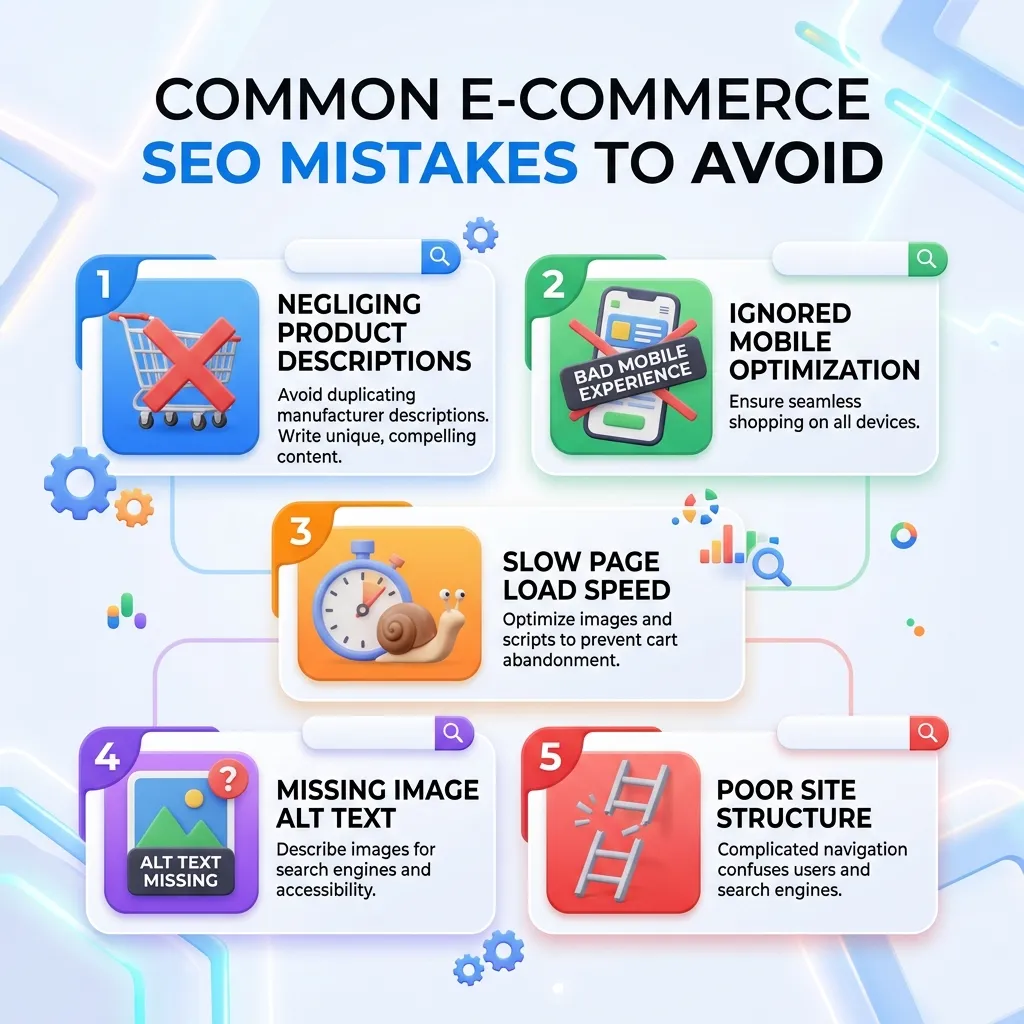
E-commerce SEO Mistakes to Avoid
Keyword Stuffing
Repeating the same keyword excessively can make product content unnatural and unhelpful.
Duplicate Product Descriptions
Copying manufacturer descriptions across hundreds of products creates little unique value.
Ignoring Category Pages
Category pages can target valuable commercial searches and should not be treated merely as product containers.
Creating Too Many Low-Value URLs
Filters, sorting parameters, and product variations can create unnecessary URL combinations.
Neglecting Mobile SEO
A desktop-friendly store can still provide a poor mobile shopping experience.
Ignoring Internal Links
Important products and categories should be connected logically throughout the site.
Focusing Only on Rankings
Higher rankings are useful, but revenue, conversions, qualified traffic, and customer experience are ultimately more important business outcomes.
Treating SEO as a One-Time Task
Products change, competitors change, search behavior changes, and technical problems appear. E-commerce SEO requires continuous improvement.
E-commerce SEO Best Practices Checklist
Use this quick checklist when reviewing your online store:
- Conduct keyword research by search intent
- Create a logical site architecture
- Optimize category pages
- Optimize product titles
- Write original product descriptions
- Optimize product images
- Improve internal linking
- Use descriptive URLs
- Manage product variants carefully
- Fix duplicate content
- Review canonical URLs
- Improve mobile usability
- Improve page speed
- Implement appropriate product structured data
- Create useful buying guides
- Build supporting content clusters
- Encourage genuine customer reviews
- Monitor indexing
- Track organic conversions and revenue
- Perform regular SEO audits
Conclusion
E-commerce SEO is more than optimizing product titles and adding keywords to descriptions. A successful strategy connects keyword research, site architecture, product optimization, category pages, technical SEO, internal linking, content, structured data, mobile experience, and conversion optimization.
The strongest approach starts with understanding what potential customers search for and then creating the most useful page for each search intent. Product pages should provide detailed information, category pages should target valuable commercial topics, and supporting content should help shoppers make purchasing decisions.
Technical SEO is equally important for online stores because product variations, filters, duplicate URLs, JavaScript, and large numbers of pages can create crawling and indexing challenges.
Finally, measure SEO using business-focused metrics such as organic conversions and revenue—not rankings or traffic alone. By continuously improving both search visibility and the shopping experience, an online store can build a sustainable organic acquisition channel and create more opportunities for long-term growth.
Frequently Asked Questions
1. What is e-commerce SEO?
E-commerce SEO is the process of optimizing an online store, products, categories, content, and technical elements to improve organic search visibility and attract qualified shoppers.
2. Why is SEO important for an online store?
SEO can help online stores attract relevant organic traffic, improve product visibility, reduce dependence on paid advertising, and generate more opportunities for sales.
3. What are the most important parts of e-commerce SEO?
The major components include keyword research, site architecture, product page optimization, category optimization, technical SEO, internal linking, content marketing, structured data, mobile optimization, and performance tracking.
4. How do I choose keywords for an e-commerce website?
Choose keywords based on search intent, relevance, competition, search demand, and business value. Separate informational, commercial, transactional, and navigational keywords.
5. Should product pages have unique descriptions?
Yes. Whenever possible, product pages should contain useful, original information that helps shoppers understand the product instead of relying entirely on manufacturer-provided descriptions.
6. Are category pages important for e-commerce SEO?
Yes. Category pages can target broader commercial searches and help users navigate related products. They should contain useful information, relevant products, and logical internal links.
7. How does internal linking help e-commerce SEO?
Internal links help users discover related products and categories while helping search engines understand the relationships and hierarchy between pages.
8. Does structured data improve e-commerce SEO?
Structured data can help search engines understand product information and may make pages eligible for certain enhanced search experiences. However, structured data does not guarantee enhanced search appearances.
9. How can I optimize product pages for SEO?
Use descriptive product titles, original descriptions, useful specifications, optimized images, clear URLs, relevant internal links, accurate availability information, and appropriate structured data.
10. How long does e-commerce SEO take to produce results?
SEO results vary depending on competition, website authority, technical condition, content quality, industry, and implementation. Some improvements may become visible relatively quickly, while competitive keywords can require substantially more time.
11. What metrics should I track for e-commerce SEO?
Track organic clicks, impressions, rankings, product and category traffic, organic conversion rate, revenue, click-through rate, average order value, and indexed pages.
12. Can small online stores benefit from e-commerce SEO?
Yes. Small stores can benefit by targeting specific products, long-tail keywords, niche categories, useful informational content, and highly relevant search queries where larger competitors may be less dominant.