Affiliate Conversion Rate Optimization: The Complete Guide
Affiliate Conversion Rate Optimization (CRO) is the process of systematically improving the percentage of visitors who complete a desired action—whether that’s a purchase, sign-up, or click—within your affiliate marketing campaigns. This guide covers funnel strategy, key metrics, tracking mechanics, SEO pitfalls, and advanced techniques to help you drive measurable results.
Affiliate marketing is a performance-based game. Every click costs you something—attention, money, or both—so converting that traffic into actual revenue isn’t optional. It’s everything.
Yet most affiliate marketers obsess over traffic volume while ignoring the deeper question: what happens after someone lands on your page? Affiliate Conversion Rate Optimization answers that question with data, strategy, and a relentless focus on improvement.
This guide is built for affiliate marketers who want to move beyond guesswork. You’ll learn how to map and optimize your Affiliate Marketing Funnel, interpret CPC in Affiliate Marketing, get Affiliate Tracking Explained in plain terms, and sidestep the Critical SEO Mistakes that quietly erode your rankings and revenue. Whether you’re just scaling past your first few conversions or managing a high-volume affiliate operation, the frameworks here apply.
By the end, you’ll have a clear, actionable roadmap to higher conversion rates and stronger ROI.
What Is Affiliate Conversion Rate Optimization?
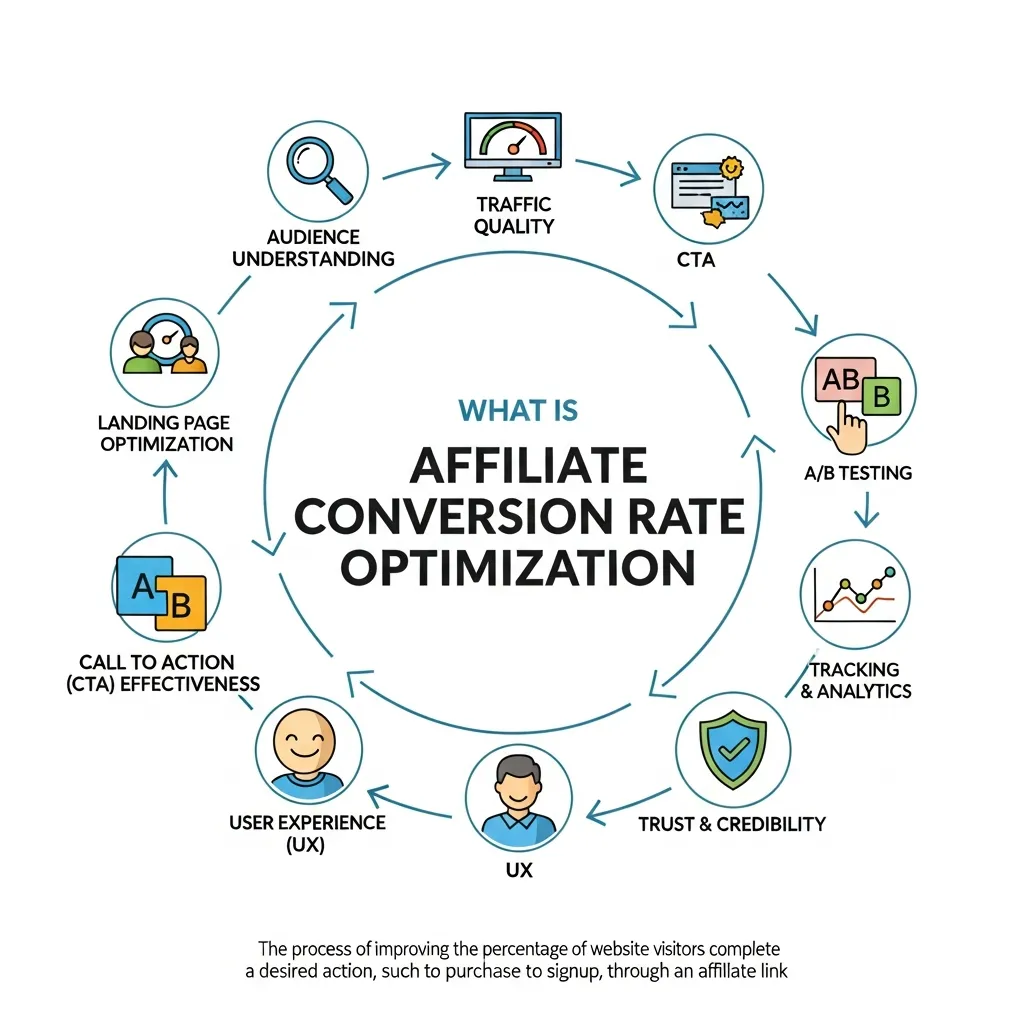
Affiliate Conversion Rate Optimization is the practice of improving the percentage of visitors who take a desired action—buying a product, submitting a lead form, clicking an affiliate link—across every stage of your affiliate campaigns.
The formula is straightforward:
Conversion Rate = (Conversions ÷ Total Visitors) × 100
If 2,000 people visit your review page and 60 click through to the merchant and convert, your conversion rate is 3%. Affiliate Conversion Rate Optimization is the process of pushing that number higher—through better copy, smarter design, sharper targeting, and tighter tracking.
Why Affiliate CRO Matters More Than Traffic Volume
Doubling your traffic is expensive. Doubling your conversion rate costs you testing time and strategy. The math strongly favors CRO.
Affiliate Conversion Rate Optimization also compounds. A 2% lift in conversions today means 2% more revenue from every campaign you run tomorrow. Over months and years, those gains stack significantly, making CRO one of the highest-leverage activities in affiliate marketing.
How Affiliate CRO and Your Affiliate Marketing Funnel Work Together
Affiliate Conversion Rate Optimization doesn’t happen in isolation. Every strategy maps directly onto your Affiliate Marketing Funnel—the path a visitor takes from first discovering your content to completing a conversion. Optimize one stage without the others and you’ll hit a ceiling. The most effective CRO practitioners treat the funnel as a unified system.
Understanding Your Affiliate Marketing Funnel
The Affiliate Marketing Funnel mirrors the classic AIDA framework: Awareness, Interest, Desire, and Action. Each stage presents distinct challenges—and distinct optimization opportunities.
- Awareness: A visitor finds your content via search, social, or paid ads. Your job here is to capture attention and communicate immediate relevance.
- Interest: The visitor engages with your content—reading a review, watching a comparison video, exploring your recommendations. Strong content, clear structure, and credible social proof all drive this stage.
- Desire: The visitor begins evaluating your recommended product or service against alternatives. Detailed reviews, side-by-side comparisons, and compelling incentives (bonuses, discounts, guarantees) convert interest into intent.
- Action: The visitor clicks your affiliate link and completes the merchant’s conversion goal. Friction here—slow page loads, confusing CTAs, weak trust signals—directly kills conversions.
How to Identify Drop-Off Points in Your Affiliate Marketing Funnel
Use Google Analytics 4 or a tool like Hotjar to map where visitors exit. High bounce rates on landing pages signal awareness-to-interest failures. Low click-through rates on affiliate links suggest desire-to-action breakdowns. Each drop-off point is a CRO opportunity.
Key Metrics in Affiliate Conversion Rate Optimization
Affiliate Conversion Rate Optimization lives and dies by data. Track the right numbers, and optimization becomes systematic. Ignore them, and you’re running on instinct.
How to Calculate and Interpret Conversion Rate in Affiliate Marketing
Your base conversion rate is conversions divided by total visitors, multiplied by 100. Context matters though: a 1% conversion rate on cold paid traffic is very different from a 1% rate on warm organic traffic arriving through a high-intent keyword. Always segment your conversion data by traffic source.
Understanding CPC in Affiliate Marketing
CPC in Affiliate Marketing—cost per click—determines how much you spend to bring each visitor into your funnel. Understanding CPC in Affiliate Marketing is non-negotiable for paid traffic affiliates because it directly shapes your profitability ceiling.
If your CPC in Affiliate Marketing is $1.50 and your average commission is $30, you need to convert at least 1 in 20 visitors just to break even. Reduce CPC in Affiliate Marketing through better ad targeting and quality scores, and your margin grows without touching your conversion rate at all.
Other Vital Metrics: CTR, EPC, and ROI
- CTR (Click-Through Rate): The percentage of page visitors who click your affiliate link. Low CTR often signals weak CTAs or poor placement.
- EPC (Earnings Per Click): Total earnings divided by total clicks. EPC is the single most useful metric for comparing affiliate offers.
- ROI: The return on your total investment—essential for paid traffic affiliates measuring campaign profitability.
Affiliate Tracking Explained: The Mechanics Behind Every Conversion
Without accurate tracking, Affiliate Conversion Rate Optimization is impossible. You can’t optimize what you can’t measure.
How Affiliate Tracking Actually Works
When a user clicks your affiliate link, a unique identifier is passed to the merchant’s site. That identifier ties the visitor to your affiliate account. When the visitor converts, the merchant’s system records the sale and credits your commission. Getting Affiliate Tracking Explained correctly means understanding where this chain can break—and it breaks more often than most marketers realize.
Types of Affiliate Tracking: Cookies, Pixels, and Server-to-Server
- Cookie-based tracking: The most common method. A cookie stored in the browser ties the visitor to your affiliate ID. Vulnerable to browser privacy settings and cookie deletion.
- Pixel tracking: A small image or JavaScript snippet fires on the confirmation page. More reliable than cookies, but still browser-dependent.
- Server-to-server (S2S) tracking: Data passes directly between servers, bypassing the browser entirely. The most reliable tracking method and increasingly the industry standard for high-volume affiliates.
Tools for Effective Affiliate Tracking
Leading platforms include Voluum, RedTrack, ClickMagick, and Impact. Each offers real-time reporting, fraud detection, and multi-channel attribution. For beginners, ClickMagick offers strong tracking fundamentals at an accessible price point.
Data Privacy and Compliance in Affiliate Tracking
GDPR, CCPA, and evolving browser policies have fundamentally changed affiliate tracking. Ensure your cookie consent banners are compliant, your tracking disclosure is visible, and your chosen platform supports privacy-safe tracking solutions like first-party cookies and S2S postback.
Strategies for Optimizing Conversion Rates in Affiliate Marketing

Landing Page Optimization: A/B Testing, CTAs, and Mobile Responsiveness
Your landing page is where Affiliate Conversion Rate Optimization produces the most visible results. A/B test one element at a time—headline, CTA button color, hero image, social proof placement—and let data determine winners. Tools like Google Optimize (now integrated into GA4), VWO, and Optimizely make split testing accessible.
Mobile responsiveness isn’t optional. Google reports that over 60% of searches now occur on mobile devices. A page that loads poorly on a smartphone will bleed conversions regardless of how well it ranks.
Offer Optimization: Choosing the Right Products and Incentives
Not all affiliate offers convert equally, even within the same niche. Evaluate offers using EPC data from your affiliate network. Look for products with strong brand recognition, clear guarantees, and competitive pricing. Pair strong offers with exclusive bonuses—free resources, extended trials, or cash-back incentives—to tip undecided visitors toward action.
Traffic Source Optimization: Quality Over Quantity
A highly targeted audience converting at 4% is far more valuable than triple the volume converting at 1%. Audit your traffic sources regularly. Organic search traffic from high-intent, product-comparison keywords typically outperforms broad social traffic for affiliate conversions.
Copywriting for Conversions: Persuasive Language and Emotional Triggers
Strong affiliate copy does three things: it identifies a problem the reader has, demonstrates that the product solves it, and removes the risk of clicking. Use specificity (“saves 3 hours per week”) over vague claims (“saves time”). Build urgency with real deadlines. Address objections directly in your copy before the reader can voice them internally.
Avoiding Critical SEO Mistakes in Affiliate Marketing
Critical SEO Mistakes can undermine even the most polished Affiliate Conversion Rate Optimization strategy by starving your funnel of organic traffic.
Common SEO Pitfalls Affiliate Marketers Make
The most damaging Critical SEO Mistakes include:
- Thin content: Review pages with fewer than 800 words and no original insight get filtered out of competitive SERPs.
- Keyword cannibalization: Multiple pages targeting the same keyword split your authority and dilute rankings.
- Over-optimized anchor text: Exact-match anchor text in every backlink looks manipulative to Google’s algorithms.
- Ignoring E-E-A-T: Google’s quality rater guidelines emphasize Experience, Expertise, Authoritativeness, and Trustworthiness—critical for affiliate sites in YMYL niches.
Keyword Research Strategies for Affiliate Marketers
Target a mix of commercial-intent keywords (“best,” “review,” “vs,” “alternative”) and informational keywords that build topical authority. Tools like Ahrefs, Semrush, and Google Search Console surface keyword opportunities your competitors are ranking for—and gaps they’ve overlooked.
On-Page and Off-Page SEO Best Practices
Naturally integrate your focus keyword—Affiliate Conversion Rate Optimization—in your H1, first paragraph, two or three H2s, and meta description. Build internal links between related affiliate content to distribute page authority. Earn backlinks through data-driven original research, expert roundups, and digital PR.
Technical SEO Considerations for Affiliate Sites
Core Web Vitals—Largest Contentful Paint, Cumulative Layout Shift, and Interaction to Next Paint—directly affect rankings and user experience. Compress images, use a CDN, minimize JavaScript, and implement proper canonical tags across your site to prevent duplicate content issues that commonly affect affiliate sites with similar product pages.
Advanced Techniques for Affiliate CRO
Personalization and Dynamic Content
Dynamic content tools like Proof, Mutiny, or custom WordPress plugins serve different headlines, CTAs, or offers based on visitor location, device, referral source, or behavior. A visitor arriving from a “best budgeting apps” article sees different content than one landing from a paid ad—and that relevance lifts conversions meaningfully.
Retargeting Strategies for Abandoned Traffic
Most visitors don’t convert on the first visit. Retargeting campaigns on Google Display, Meta, or native ad platforms re-engage visitors who showed interest but didn’t click through. Segment your retargeting audiences by behavior—time on page, pages visited, affiliate links clicked—and serve ads tailored to each segment.
Utilizing Exit-Intent Pop-Ups and Lead Magnets
Exit-intent technology detects when a visitor’s cursor moves toward the browser’s back button and triggers a pop-up. Effective exit-intent offers include comparison guides, discount codes passed through affiliate links, or email capture sequences that nurture leads over time. OptinMonster and Sleeknote are two reliable tools for implementing exit-intent flows.
Leveraging Data Analytics and AI for Deeper Insights
AI-powered analytics platforms like Triple Whale, Northbeam, and custom GA4 explorations surface patterns in conversion data that manual analysis misses. Use AI to identify which content pieces drive the highest EPC, which traffic sources produce the best lifetime value customers, and where your Affiliate Marketing Funnel bleeds the most revenue.
Real-World Examples of Successful Affiliate CRO
Case Study 1 — Review Site A/B Test: A technology affiliate site tested two versions of a product review page. Version A used a generic CTA (“Click here”). Version B used a benefit-driven CTA (“Claim your 30-day free trial”). Version B produced a 34% lift in click-through rate, translating directly into higher commissions without any additional traffic spend.
Case Study 2 — Funnel Segmentation: A finance affiliate segmented their email list by product interest (credit cards vs. personal loans). Tailored landing pages for each segment increased conversion rates by 28% compared to a single generic landing page—demonstrating the compounding impact of personalization across the Affiliate Marketing Funnel.
Lesson learned: The highest-performing affiliate campaigns consistently combine precise tracking, segmented audiences, and continuous testing. No single tactic produces lasting results in isolation.
Future Trends in Affiliate Marketing and CRO

AI and Machine Learning: Predictive bidding, dynamic content personalization, and AI-generated ad copy are shifting from competitive advantages to baseline expectations. Affiliates who integrate these tools early will hold meaningful advantages in CPC efficiency and conversion rates.
Voice Search Optimization: As voice search grows, conversational long-tail keywords become increasingly valuable. Structuring content around natural-language questions improves both voice search visibility and AI answer engine citations.
Evolving Consumer Behavior: Privacy-first browsing, rising ad fatigue, and growing consumer skepticism mean trust signals—genuine reviews, transparent disclosures, authoritative content—will carry more conversion weight than ever before. Affiliate Conversion Rate Optimization in the next few years will reward authenticity as much as technical precision.
Take Your Affiliate Conversions to the Next Level
Affiliate Conversion Rate Optimization isn’t a one-time project—it’s an ongoing discipline. The marketers who consistently outperform their competitors aren’t necessarily running better offers or spending more on traffic. They’re measuring more carefully, testing more systematically, and optimizing every layer of their Affiliate Marketing Funnel with equal rigor.
Start with your highest-traffic pages. Audit your tracking setup. Identify your biggest drop-off points. Then test, measure, and iterate. The compounding effect of incremental improvements in Affiliate Conversion Rate Optimization will outperform any single traffic spike—every time.
Frequently Asked Questions
1. What is a good affiliate conversion rate?
A good affiliate conversion rate varies by niche and traffic source. Generally, 1–3% is considered average for cold traffic. Warm, high-intent organic traffic can produce rates of 5–10% or higher on well-optimized pages. Always benchmark against your own historical data rather than generic industry averages.
2. How does the Affiliate Marketing Funnel impact CRO efforts?
Your Affiliate Marketing Funnel determines where visitors enter, how they progress, and where they exit before converting. Affiliate Conversion Rate Optimization is most effective when applied at every funnel stage—improving awareness content, deepening engagement in the interest phase, and reducing friction at the action stage—rather than focusing on the bottom of the funnel alone.
3. What is CPC in Affiliate Marketing, and why does it matter?
CPC in Affiliate Marketing is the cost you pay per click when running paid traffic campaigns. Understanding CPC in Affiliate Marketing is critical because it sets your profitability floor. If your CPC in Affiliate Marketing exceeds your earnings per click (EPC), your campaigns run at a loss regardless of conversion volume.
4. Why is Affiliate Tracking so important for optimization?
Accurate affiliate tracking is the foundation of all Affiliate Conversion Rate Optimization decisions. Without it, you cannot identify which traffic sources, pages, or offers drive conversions—making optimization entirely guesswork. Getting Affiliate Tracking Explained and implemented correctly ensures every optimization decision is backed by reliable data.
5. What are the most common Critical SEO Mistakes affiliate marketers make?
The most damaging Critical SEO Mistakes include publishing thin content with no original insight, targeting the same keyword across multiple pages (cannibalization), using over-optimized exact-match anchor text, and neglecting technical SEO fundamentals like page speed and Core Web Vitals. Each of these Critical SEO Mistakes can suppress organic rankings and starve your funnel of traffic.
6. How often should I perform A/B testing for CRO?
Run A/B tests continuously, but sequentially—test one element at a time and only move to the next test once you have a statistically significant result (typically 95% confidence). For pages with high traffic, you may reach significance in one to two weeks. Smaller sites may need to run tests for four to six weeks.
7. What role does landing page design play in Affiliate Conversion Rate Optimization?
Landing page design directly influences how visitors process information and whether they take action. Clear hierarchy, fast load times, prominent CTAs, strong trust signals (reviews, badges, guarantees), and mobile responsiveness all contribute to conversion rate. A well-designed landing page can double conversion rates compared to a generic, cluttered alternative.
8. How can I improve my website’s loading speed for better conversions?
Compress and serve images in next-gen formats (WebP), minimize CSS and JavaScript, enable browser caching, use a Content Delivery Network (CDN), and choose a high-performance hosting provider. Tools like Google PageSpeed Insights and GTmetrix identify specific bottlenecks and prioritize fixes.
9. What tools are recommended for Affiliate Tracking?
Voluum, RedTrack, ClickMagick, and Impact are among the most widely used affiliate tracking platforms. For beginners, ClickMagick offers solid tracking fundamentals. For high-volume affiliates with complex multi-channel campaigns, Voluum and RedTrack provide advanced features including server-to-server postback tracking and AI-powered fraud detection.
10. How do I choose the best affiliate offers for higher conversion rates?
Evaluate offers using EPC (Earnings Per Click) data from your affiliate network, which reflects real-world conversion performance. Prioritize offers with established brand recognition, generous cookie windows, competitive pricing, and responsive affiliate support. Always test multiple offers against the same traffic source before scaling spend.
11. What is the difference between conversion rate and click-through rate in affiliate marketing?
Click-through rate (CTR) measures the percentage of page visitors who click your affiliate link. Conversion rate measures the percentage of those clicks (or total visitors, depending on your definition) who complete the merchant’s goal—typically a purchase or sign-up. Both matter in Affiliate Conversion Rate Optimization: low CTR means your link placement or CTA is weak; low post-click conversion rate means the merchant’s page or your audience targeting needs work.
12. How can I use analytics to identify areas for CRO improvement?
Start with behavior flow reports in Google Analytics 4 to identify where visitors exit your funnel. Use heatmaps (Hotjar, Microsoft Clarity) to see where users click and how far they scroll. Segment conversion data by traffic source, device type, and landing page to surface high-opportunity areas. Prioritize fixes on pages with high traffic and below-average conversion rates for the fastest impact.