PPC Advertising Strategy: A Complete Guide to Paid Campaigns
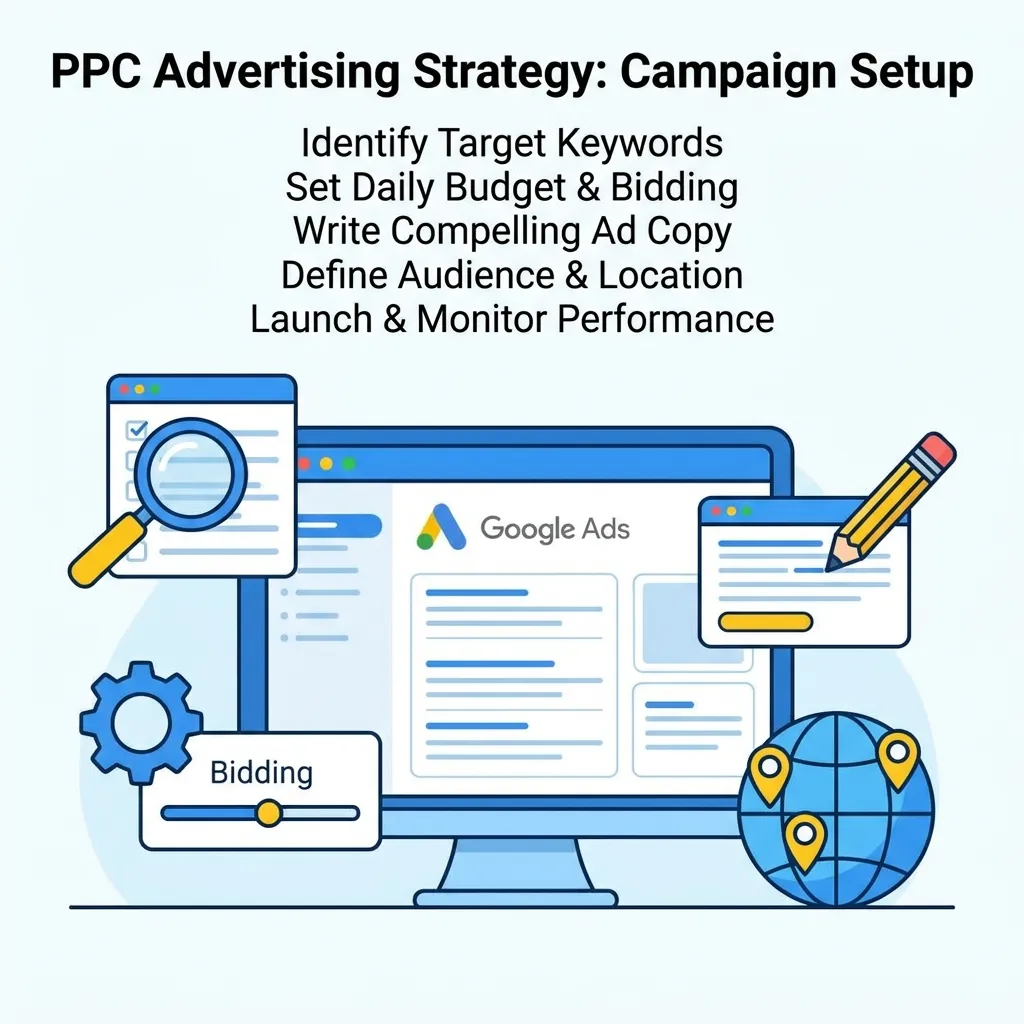
A strong PPC advertising strategy helps businesses reach potential customers when they are actively searching for products, services, or solutions. Instead of waiting for organic rankings to generate traffic, businesses can use paid advertising to place relevant offers in front of targeted audiences and pay when users interact with their ads.
However, simply launching a paid campaign does not guarantee results. Successful PPC advertising requires careful planning, relevant keywords, compelling ad copy, accurate audience targeting, appropriate budgets, optimized landing pages, and continuous performance analysis.
This guide explains how to create a PPC advertising strategy, optimize campaigns, measure performance, avoid common mistakes, and build a sustainable paid advertising approach for different types of businesses.
What Is a PPC Advertising Strategy?
A PPC advertising strategy is a structured plan for creating, managing, and optimizing pay-per-click campaigns to achieve specific marketing goals.
PPC stands for pay-per-click, a digital advertising model where advertisers generally pay when someone clicks their advertisement. Search advertising is one of the most common forms of PPC, but paid campaigns can also appear across display networks, shopping platforms, social media, and other advertising channels.
A complete PPC strategy determines:
- What the campaign should accomplish
- Who should see the advertisements
- Which keywords or audiences to target
- What type of ads to create
- How much money to spend
- Which bidding approach to use
- Where users should land after clicking
- Which performance metrics to monitor
- How campaigns should be optimized over time
The goal is not simply to generate clicks. A successful PPC advertising strategy focuses on generating valuable actions such as purchases, leads, registrations, bookings, calls, or other conversions.
Why Is a PPC Advertising Strategy Important?
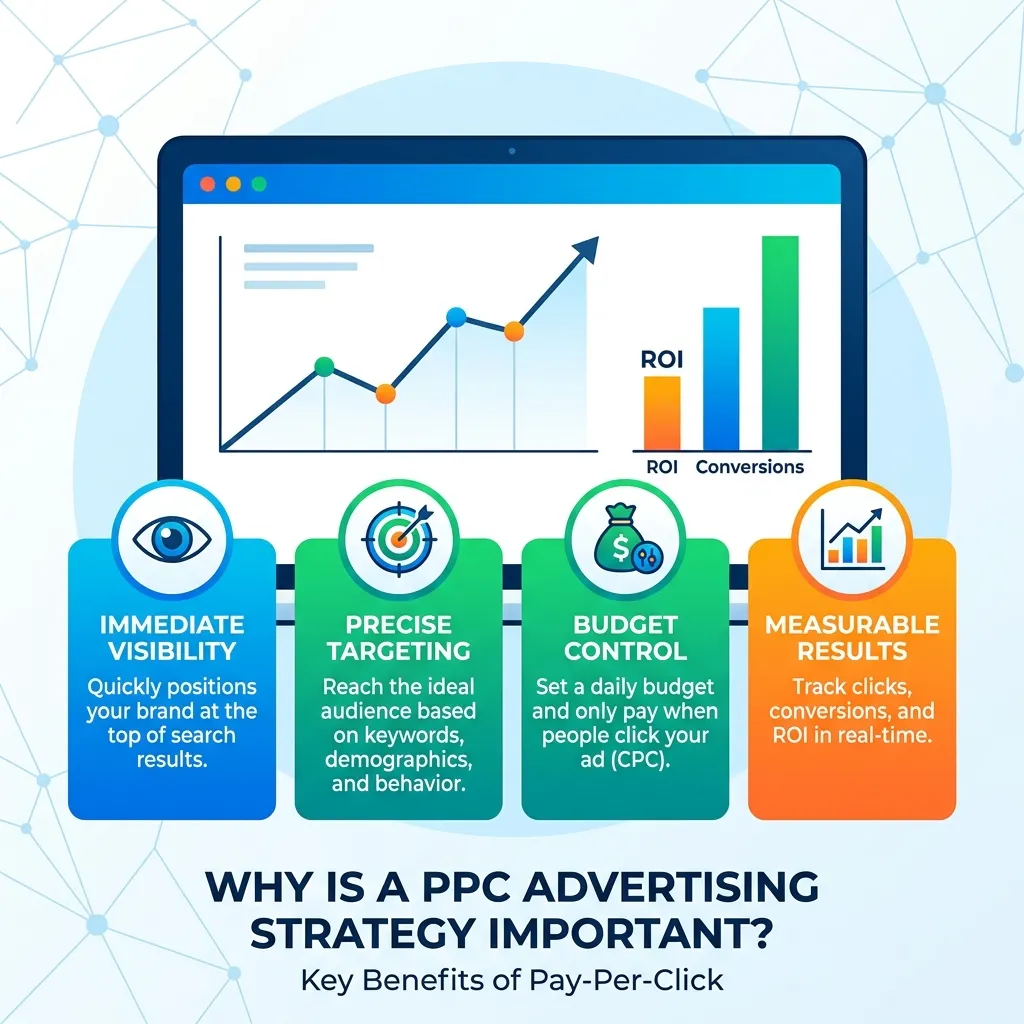
Without a defined strategy, PPC campaigns can quickly become expensive. Businesses may target broad keywords, attract irrelevant visitors, write weak advertisements, or spend money without knowing which campaigns generate actual business results.
A structured approach helps advertisers use their budgets more effectively.
Faster Visibility
Paid advertising can help businesses appear prominently for relevant searches without waiting months to build organic rankings.
Targeted Traffic
Advertisers can target users based on keywords, demographics, interests, locations, devices, and other available signals depending on the platform.
Budget Control
PPC platforms allow advertisers to establish campaign budgets and adjust spending according to performance.
Measurable Results
Businesses can track impressions, clicks, conversions, conversion value, cost per conversion, and return on ad spend.
Flexible Optimization
Campaigns can be adjusted based on performance. Advertisers can pause underperforming keywords, improve advertisements, modify bids, test landing pages, or redistribute budgets.
Key Elements of a Successful PPC Advertising Strategy
An effective PPC campaign consists of several connected components. Weakness in one area can affect the performance of the entire campaign.
1. Clear Campaign Goals
Before launching a campaign, define what success means.
Possible goals include:
- Increasing online sales
- Generating qualified leads
- Increasing website traffic
- Getting phone calls
- Promoting a product
- Increasing bookings
- Growing registrations
- Building brand awareness
For example, an e-commerce company may prioritize purchases and revenue, while a service business may focus on qualified leads and phone calls.
Your goal should determine your campaign structure, conversion tracking, budget allocation, and optimization process.
2. Audience Research
Understanding the target audience is essential for building an effective PPC advertising strategy.
Consider:
- Who is most likely to purchase?
- What problems are they trying to solve?
- What products or services are they searching for?
- What language do they use?
- Where are they located?
- What factors influence their buying decisions?
- Are they ready to purchase or still researching?
Audience research can help you create more relevant advertisements and landing pages.
3. Keyword Research
For search campaigns, keyword research is one of the most important parts of PPC planning.
Look for keywords that are:
- Relevant to the offer
- Closely connected to user intent
- Commercially valuable
- Specific enough to attract qualified visitors
- Reasonable within your budget
For example, someone searching for “running shoes” may have broad informational or commercial intent. A search such as “buy men’s running shoes online” generally indicates stronger purchase intent.
Organizing keywords by intent can help create more relevant campaigns and advertisements.
How to Build a PPC Advertising Strategy
Creating a PPC campaign should be a planned process rather than a one-time setup.
Step 1: Define Your Marketing Objective
Start by determining the primary business outcome.
For example:
Goal: Generate leads for a web development service.
Target action: Completed inquiry form.
Primary KPI: Cost per qualified lead.
This makes it easier to evaluate whether the campaign is actually contributing to business growth.
Step 2: Identify Your Ideal Customers
Build a basic customer profile.
Consider their:
- Location
- Age range
- Interests
- Industry
- Purchasing behavior
- Search behavior
- Pain points
- Budget
- Buying stage
The more accurately you understand your audience, the easier it becomes to create relevant targeting and messaging.
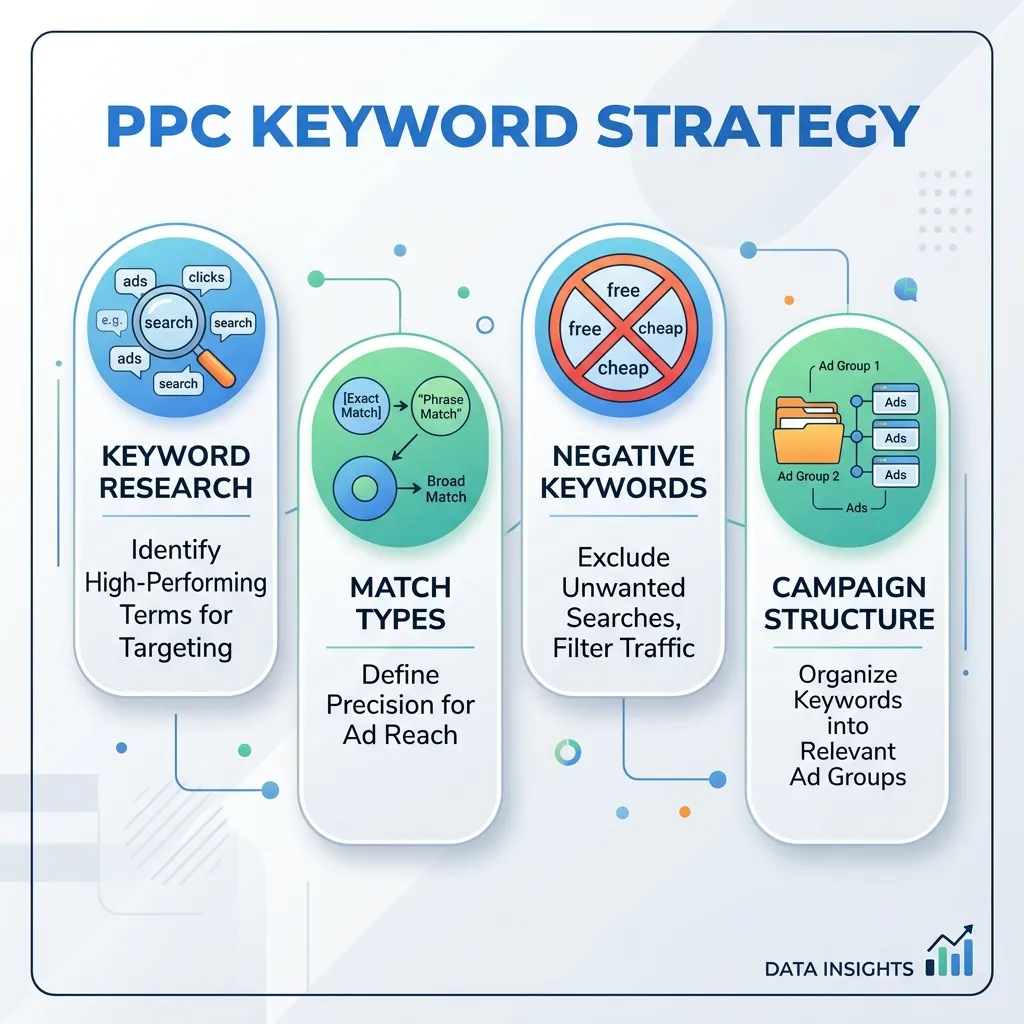
Step 3: Research Keywords
Create keyword groups based on products, services, problems, and purchase intent.
Avoid placing unrelated keywords into one ad group. Tightly organized keyword groups can make it easier to write relevant advertisements and analyze performance.
You should also identify negative keywords.
Negative keywords help prevent ads from showing for searches that are unlikely to produce valuable results.
For example, if a company sells premium software, it might exclude searches containing terms such as “free” if free users are not part of its target market.
Step 4: Select the Right Advertising Platform
Different platforms serve different marketing objectives.
Common options include:
- Google Ads
- Microsoft Advertising
- Meta advertising platforms
- LinkedIn advertising
- Other search, display, shopping, or social advertising networks
Search advertising is useful when users are actively looking for something. Social advertising can be useful for reaching audiences based on interests, behaviors, demographics, and other targeting signals.
Choose platforms according to your audience and business goals rather than trying to advertise everywhere at once.
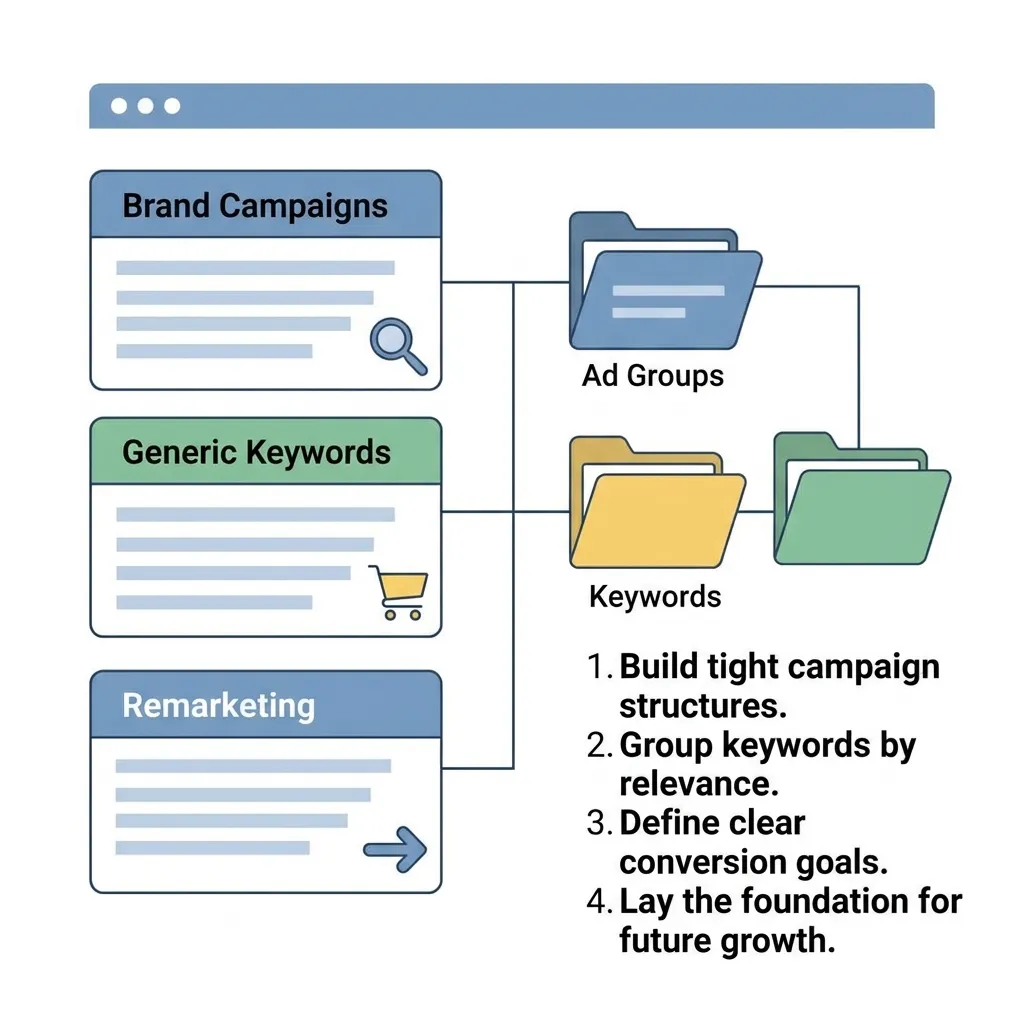
Step 5: Organize Campaigns and Ad Groups
A well-structured campaign makes management easier.
A basic structure might look like:
Campaign: Web Design Services
Ad Group 1: Business Website Design
Ad Group 2: E-commerce Website Design
Ad Group 3: Custom Web Development
Each ad group can contain closely related keywords and advertisements.
This organization helps maintain relevance between the user’s search, advertisement, and landing page.
Step 6: Write Relevant Ad Copy
Your advertisement needs to communicate value quickly.
Effective PPC ads often include:
- A relevant headline
- A clear value proposition
- Important product or service benefits
- A specific call to action
- Relevant keywords where appropriate
- Trust signals when available
For example:
Headline: Custom E-commerce Website Development
Description: Build a fast, conversion-focused online store with custom features. Request a consultation today.
The message should accurately represent what users will find after clicking.
Step 7: Create Dedicated Landing Pages
Sending every PPC visitor to the homepage is not always the best approach.
A dedicated landing page should closely match the advertisement and search intent.
For example, an advertisement promoting “e-commerce website development” should ideally lead to a page specifically about e-commerce development rather than a generic homepage.
A strong landing page should have:
- A clear headline
- Relevant information
- Strong benefits
- Easy navigation
- Trust signals
- Clear calls to action
- Mobile-friendly design
- Fast loading performance
- A simple conversion process
Step 8: Set Your Budget
Your budget should be connected to your business objectives and expected conversion economics.
Consider:
- Average customer value
- Target cost per acquisition
- Expected conversion rate
- Average click cost
- Available monthly budget
- Profit margin
For example, if your target cost per lead is $30 and you need approximately 100 leads per month, your potential target acquisition budget would be around $3,000 before considering other campaign variables.
Actual costs will vary depending on the market, competition, platform, targeting, and campaign performance.
Step 9: Choose a Bidding Approach
PPC platforms offer different bidding options depending on the campaign type and objective.
Common approaches include:
- Manual bidding
- Automated bidding
- Conversion-focused bidding
- Traffic-focused bidding
- Value-focused bidding
The right option depends on your campaign goals, conversion data, budget, and platform capabilities.
Avoid changing bidding settings constantly. Give campaigns enough time and data to produce meaningful performance signals whenever possible.
PPC Keyword Strategy
Keyword selection should focus on intent rather than search volume alone.
High-Intent Keywords
These keywords often indicate that the user is closer to taking action.
Examples include:
- Buy running shoes online
- PPC agency for small business
- Hire web developer
- E-commerce SEO services
Informational Keywords
These searches usually indicate that users are researching.
Examples include:
- What is PPC advertising?
- How does paid search work?
- PPC advertising benefits
Informational keywords can have value, but they may not produce conversions as efficiently as high-intent commercial searches.
Long-Tail Keywords
Long-tail keywords are more specific search phrases.
For example:
“PPC advertising strategy for small e-commerce businesses”
is more specific than:
“PPC advertising.”
Long-tail keywords may attract fewer searches but can sometimes provide more qualified traffic.
Audience Targeting in PPC
Keyword targeting is only one part of modern paid advertising.
Depending on the platform and campaign type, advertisers may use audience signals based on:
- Location
- Language
- Demographics
- Interests
- Previous website interactions
- Customer lists
- Search behavior
- Device usage
Audience segmentation allows advertisers to create different messages for different groups.
For example, returning website visitors may receive a different advertisement from users who have never interacted with the brand.
PPC Advertising Strategy for E-commerce
E-commerce businesses can use PPC campaigns to promote products, categories, and shopping experiences.
A strong e-commerce strategy may include:
- Product-focused campaigns
- Shopping campaigns
- Brand campaigns
- Non-brand search campaigns
- Remarketing
- Promotional campaigns
- Seasonal campaigns
Product titles, images, prices, availability, landing pages, and conversion tracking can all affect campaign performance.
Businesses should also connect advertising performance with actual revenue rather than evaluating campaigns based only on clicks.
PPC Strategy for Small Businesses
Small businesses often have limited advertising budgets, making efficiency particularly important.
A practical approach is to:
- Start with a narrow geographic area.
- Target highly relevant keywords.
- Use strong purchase-intent terms.
- Create dedicated landing pages.
- Track conversions from the beginning.
- Monitor search terms regularly.
- Remove irrelevant traffic.
- Increase spending only when campaigns demonstrate acceptable performance.
Small businesses should avoid spreading a limited budget across too many campaigns or platforms before establishing what works.
Important PPC Metrics to Track
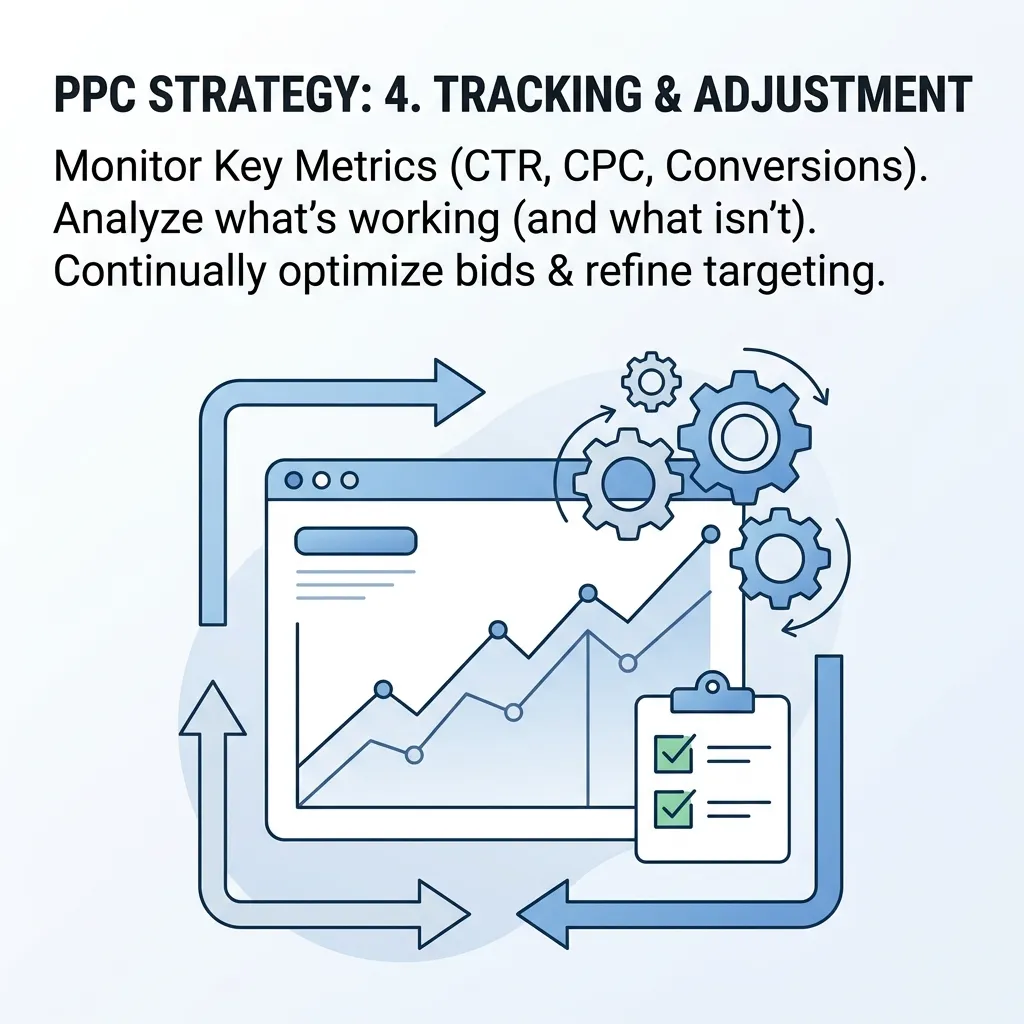
Tracking the right metrics helps determine whether your campaigns are producing meaningful results.
Impressions
Impressions represent how often an advertisement is displayed.
Clicks
Clicks show how many times users interacted with the advertisement.
Click-Through Rate
CTR measures the percentage of impressions that resulted in clicks.
The basic formula is:
CTR = Clicks ÷ Impressions × 100
Cost Per Click
CPC represents the average amount paid for each click.
Average CPC = Total Cost ÷ Total Clicks
Conversion Rate
Conversion rate measures how frequently clicks result in a desired conversion.
Conversion Rate = Conversions ÷ Clicks × 100
Cost Per Conversion
This metric shows how much advertising spend is required to generate a conversion.
Cost Per Conversion = Total Advertising Cost ÷ Total Conversions
Return on Ad Spend
ROAS compares advertising revenue with advertising spend.
ROAS = Conversion Value ÷ Advertising Cost
These metrics should be interpreted together. A campaign can have a high CTR but poor profitability if the traffic does not convert.
How to Optimize PPC Campaigns
Optimization should be an ongoing process.
Review Search Terms
Search-term analysis can reveal irrelevant queries that trigger your ads.
Add unsuitable searches to your negative keyword strategy when appropriate.
Improve Underperforming Ads
Test different:
- Headlines
- Value propositions
- Calls to action
- Offers
- Benefits
- Messaging angles
Avoid changing everything simultaneously because it becomes difficult to determine what caused the performance change.
Improve Landing Pages
If an advertisement receives many clicks but produces few conversions, investigate the landing page.
Check:
- Page speed
- Mobile usability
- Message relevance
- Form length
- Call-to-action visibility
- Trust signals
- Offer clarity
Adjust Budgets
Move more budget toward campaigns and ad groups that consistently generate valuable outcomes.
However, do not make budget decisions based on very limited data.
Refine Targeting
If a particular location, audience, device, or keyword segment consistently performs poorly, consider reducing its exposure or excluding it when appropriate.
Common PPC Advertising Mistakes
Even experienced advertisers can make mistakes that reduce campaign efficiency.
Targeting Too Broadly
Broad targeting can generate large amounts of traffic without enough qualified users.
Ignoring Negative Keywords
Failing to filter irrelevant searches can waste budget.
Sending Traffic to the Homepage
A generic homepage may not match the specific intent behind the advertisement.
Focusing Only on Clicks
Clicks are useful, but they do not automatically represent business success.
Poor Conversion Tracking
Without accurate tracking, advertisers cannot reliably determine which campaigns generate leads or sales.
Changing Campaigns Too Frequently
Constant changes can make it difficult to collect enough data for meaningful analysis.
Ignoring Mobile Users
A significant portion of paid traffic may come from mobile devices. Landing pages and forms should work properly on smaller screens.
Writing Generic Ad Copy
Ads that do not clearly communicate their value may struggle to attract qualified users.
Advanced PPC Optimization Techniques
Once your campaigns have sufficient data, you can move beyond basic optimization.
Segment Performance
Analyze results by:
- Device
- Location
- Audience
- Keyword
- Search term
- Time period
- Campaign
- Landing page
This can reveal patterns that are hidden in overall campaign metrics.
Use Conversion Value
Not all conversions are equally valuable.
A $1,000 purchase and a $20 purchase should not necessarily be treated the same way.
Where appropriate, assign accurate conversion values so campaign decisions can consider business value.
Test Different Landing Pages
Landing-page testing can help identify which page structures, offers, and messaging generate better conversion rates.
Use Remarketing
Users who previously visited your website may be more familiar with your brand than completely new prospects.
Remarketing can help re-engage these users when appropriate.
Analyze Customer Acquisition Costs
Instead of optimizing advertising metrics in isolation, connect PPC performance to customer acquisition costs and customer value.
This provides a more complete view of campaign profitability.
PPC Advertising Best Practices
Follow these practices when developing your campaigns:
- Define measurable goals before launching.
- Research your target audience.
- Use relevant keywords.
- Group closely related keywords.
- Add negative keywords.
- Write specific and useful ad copy.
- Match ads with landing pages.
- Track meaningful conversions.
- Monitor performance regularly.
- Test different messaging.
- Review search terms.
- Optimize based on business outcomes.
- Keep mobile users in mind.
- Scale campaigns gradually.
- Document important changes.
PPC Advertising Strategy vs SEO Strategy
PPC and SEO both help businesses gain visibility in search engines, but they work differently.
| PPC Advertising | SEO |
|---|---|
| Requires advertising spend | Primarily focuses on organic visibility |
| Can generate traffic quickly | Usually takes longer to build |
| Allows direct campaign targeting | Relies on organic ranking factors |
| Traffic generally stops when ads stop | Rankings can continue generating traffic |
| Highly measurable at campaign level | Requires broader organic performance analysis |
| Useful for immediate testing | Useful for long-term search visibility |
Businesses do not necessarily have to choose between the two.
A combined approach can allow PPC to generate immediate visibility while SEO builds sustainable organic traffic over time.
How to Measure PPC ROI
The ultimate goal of a PPC advertising strategy should be business value, not simply traffic.
Start by determining:
- Total advertising cost
- Number of conversions
- Conversion value
- Customer acquisition cost
- Average customer value
- Revenue generated
For e-commerce, revenue and ROAS can be particularly useful. For lead-generation businesses, you may need to connect leads with actual sales data to determine the true return.
For example, generating 100 leads is not necessarily successful if most leads are unqualified. A campaign producing 40 highly qualified leads that become customers may be more valuable.Read more details : SEO vs PPC
How Often Should You Optimize PPC Campaigns?
PPC campaigns should be monitored regularly, but not every metric needs to be changed every day.
A practical routine can include:
Daily: Check major issues, spending anomalies, and campaign status.
Weekly: Review keywords, search terms, ads, conversions, and budget allocation.
Monthly: Evaluate overall profitability, audience performance, landing pages, and strategic direction.
The appropriate frequency depends on campaign size, budget, traffic volume, and business goals.
PPC Advertising Strategy for Long-Term Growth
PPC should not always be treated as a short-term traffic source.
A mature strategy can use campaign data to discover:
- High-performing products
- Valuable customer segments
- Strong commercial keywords
- Effective messaging
- Profitable geographic markets
- Seasonal demand
- Customer acquisition trends
These insights can also influence other marketing activities, including SEO, content marketing, landing-page optimization, and product positioning.
Over time, the goal should be to build a repeatable system where campaigns are measured, tested, optimized, and scaled according to reliable business data.
Final Thoughts
A successful PPC advertising strategy requires much more than launching advertisements and waiting for clicks. Businesses need clear goals, accurate audience research, relevant keywords, persuasive ads, optimized landing pages, appropriate budgets, conversion tracking, and continuous analysis.
Start with a focused campaign, measure meaningful outcomes, identify what works, and gradually scale successful approaches. By connecting PPC performance to actual business results rather than vanity metrics, businesses can create paid campaigns that support sustainable growth.
Frequently Asked Questions
What is a PPC advertising strategy?
A PPC advertising strategy is a structured plan for creating, targeting, managing, measuring, and optimizing pay-per-click advertising campaigns to achieve specific business goals.
How does PPC advertising work?
PPC advertising allows businesses to display paid advertisements to targeted users. Advertisers generally pay when someone clicks an ad, although pricing models can vary by campaign type and platform.
Is PPC better than SEO?
Neither is universally better. PPC can provide faster visibility, while SEO can build long-term organic visibility. Many businesses benefit from using both.
How much does PPC advertising cost?
PPC costs vary significantly depending on the platform, industry, competition, keywords, location, audience, and campaign goals. Businesses can usually control spending through campaign and account budgets.
What is the most important PPC metric?
There is no single metric that is most important for every campaign. Conversion rate, cost per conversion, conversion value, ROAS, and customer acquisition cost can be particularly useful depending on the business objective.
How can I reduce PPC costs?
You can potentially improve efficiency by targeting more relevant keywords, adding negative keywords, improving ad relevance, optimizing landing pages, refining audiences, and reallocating budget toward better-performing campaigns.
What are negative keywords in PPC?
Negative keywords are terms used to prevent advertisements from appearing for specific searches that are unlikely to generate valuable traffic.
What is PPC campaign optimization?
PPC campaign optimization involves analyzing campaign data and making informed changes to keywords, advertisements, targeting, bids, budgets, landing pages, and other settings to improve performance.
Can small businesses use PPC advertising?
Yes. Small businesses can use PPC with relatively focused campaigns and controlled budgets. Narrow geographic targeting and high-intent keywords can help make limited budgets more efficient.
What is a good PPC conversion rate?
There is no universal benchmark because conversion rates vary by industry, offer, traffic source, audience, device, and conversion type. Your own historical performance and profitability are often more useful benchmarks.
Should PPC traffic go to a landing page?
In many cases, a dedicated landing page can be more effective because it allows the content to closely match the advertisement and search intent. The best destination depends on the campaign objective.
How long does it take to see PPC results?
PPC can generate traffic soon after campaigns become active, but meaningful optimization requires enough conversion and performance data. The time required varies according to budget, traffic volume, conversion cycle, and campaign complexity.