Shopify vs WooCommerce: Which Platform Is Right for You?
Shopify vs WooCommerce is one of the most common questions anyone starting an online store runs into, and the honest answer is that neither platform is universally better — they’re built for different kinds of store owners. Shopify is a fully hosted, all-in-one solution built for speed and simplicity, while WooCommerce is a free, open-source plugin for WordPress that trades a steeper setup for near-total control. This guide compares both platforms across cost, ease of use, customization, SEO, scalability, and support so you can pick the one that actually fits how you want to run your store.
Choosing an ecommerce platform is one of the first big decisions a new store owner has to make, and it’s one that’s genuinely hard to undo later without a painful migration. Shopify and WooCommerce dominate this conversation for good reason — together they power a massive share of online stores, from single-founder side projects to multi-million dollar brands. But they take almost opposite approaches to how a store gets built and run.
This guide breaks down exactly how Shopify vs WooCommerce compares across the factors that actually matter: what each one costs in practice, how much technical work is involved, how far you can customize the store, and which one scales better as a business grows.
Shopify vs WooCommerce: The Core Difference
Shopify is a fully hosted software-as-a-service platform. You sign up, pay a monthly fee, and Shopify handles the hosting, security, and infrastructure behind the scenes. WooCommerce is different — it’s a free plugin that turns a WordPress website into an online store, which means you’re responsible for your own hosting, and the platform gives you far more room to customize how everything works under the hood.
That single distinction — hosted platform versus self-hosted plugin — explains almost every other difference between the two. Shopify trades flexibility for simplicity and reliability. WooCommerce trades a steeper learning curve for control and lower baseline cost.
Shopify vs WooCommerce: Pricing Compared
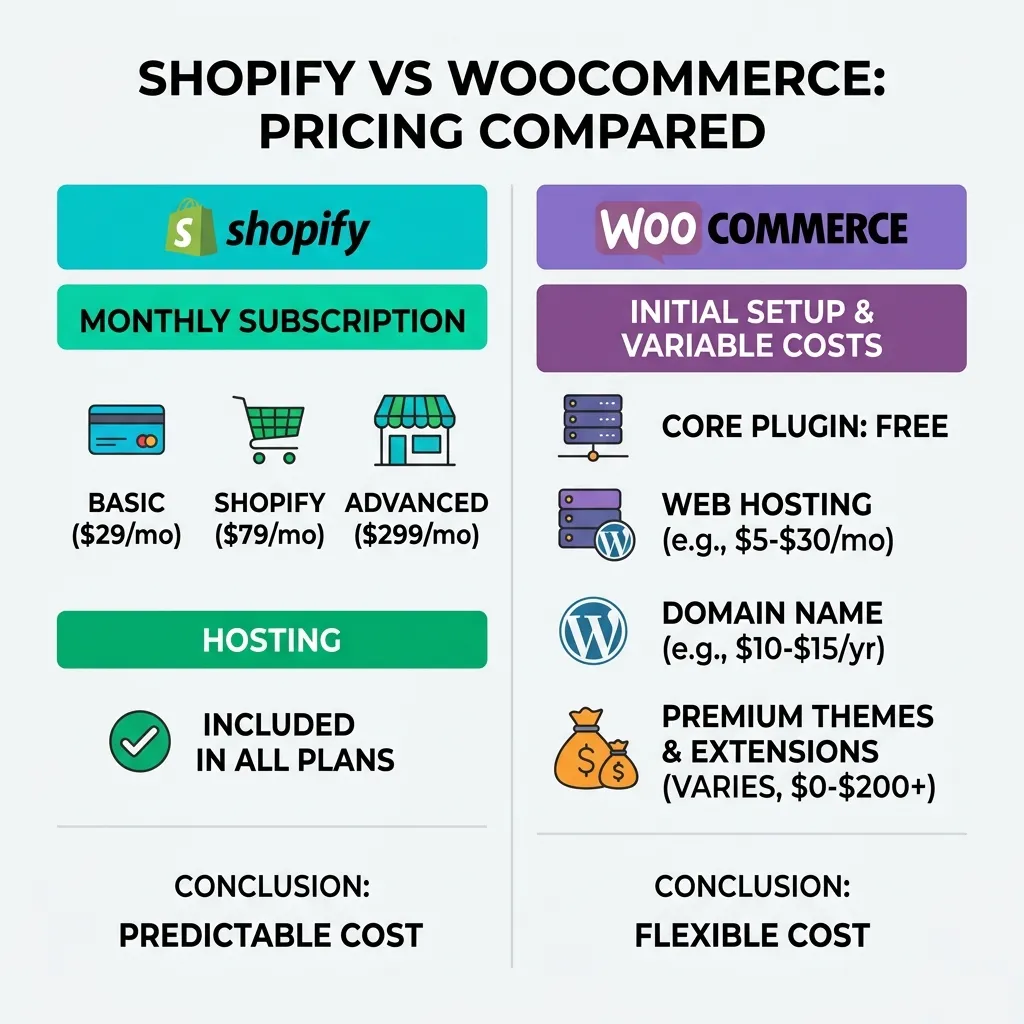
Shopify’s pricing is straightforward: a predictable monthly subscription that includes hosting, security, and support, with transaction fees that can be reduced or eliminated by using Shopify’s own payment processor. Costs typically rise as you add premium themes, apps, or upgrade to higher-tier plans for advanced features.
WooCommerce itself is free, but that doesn’t mean running a WooCommerce store is free. You’ll need to pay separately for hosting, a domain, an SSL certificate, and likely a handful of premium plugins for functionality that comes built into Shopify out of the box. For a small store with modest traffic, WooCommerce can end up cheaper overall. For a growing store that needs reliable performance under heavy traffic, the cost of quality hosting and the technical work to maintain it can close that gap quickly.
Shopify vs WooCommerce: Ease of Use and Setup
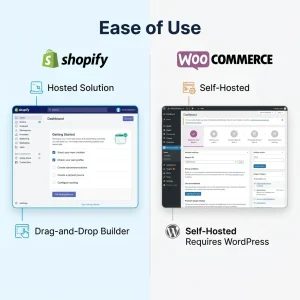
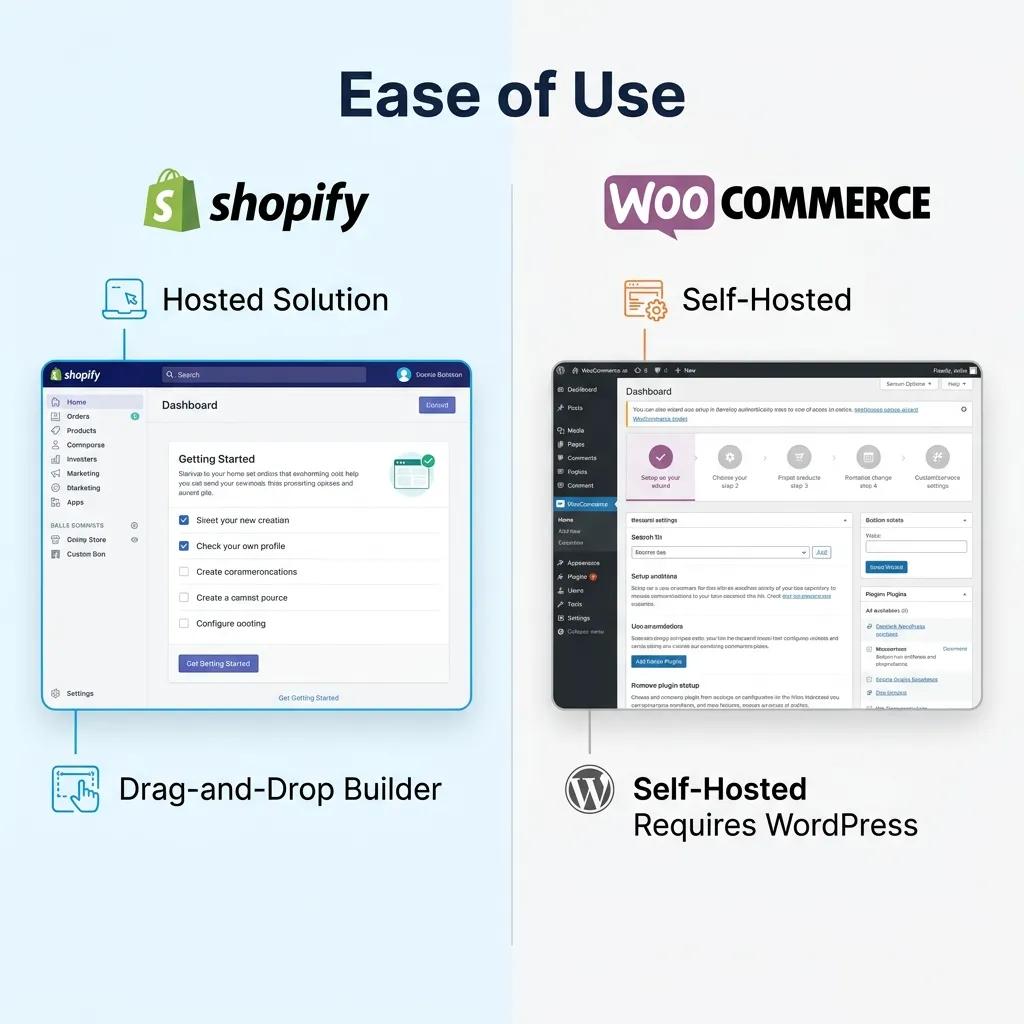
This is where the two platforms diverge most sharply. Shopify is designed for someone with no coding background to launch a fully functional store in a single afternoon. Themes, payment processing, and hosting all come pre-configured, and the admin interface is built specifically for ecommerce rather than adapted from a general-purpose tool.
WooCommerce requires more upfront setup. You need a WordPress installation, hosting configured correctly, and typically several plugins installed and configured just to reach feature parity with what Shopify offers by default. This isn’t necessarily a downside if you’re comfortable with WordPress already or have a developer on hand, but it is a real barrier for a solo founder trying to launch quickly with no technical background.
Shopify vs WooCommerce: Customization and Flexibility
Here the advantage flips. WooCommerce, as an open-source plugin running on WordPress, gives store owners near-total control over design, functionality, and how the store integrates with other tools. If a feature doesn’t exist, a developer can build it directly rather than waiting on the platform to support it.
Shopify is more restrictive by design. Customization happens within Shopify’s theme system and app ecosystem, which covers the vast majority of use cases well but occasionally hits a wall for highly specific or unusual requirements. Shopify has expanded what’s possible significantly in recent years, but WooCommerce still wins clearly on raw flexibility for anyone willing to invest the development time.
Shopify vs WooCommerce: SEO Capabilities
Both platforms are capable of strong SEO performance, but the mechanics differ. WooCommerce benefits from being built on WordPress, which has a long track record as a strong foundation for content-driven SEO and integrates naturally with plugins built specifically for search optimization. Our complete guide to ecommerce SEO covers many of the fundamentals that apply across both platforms.
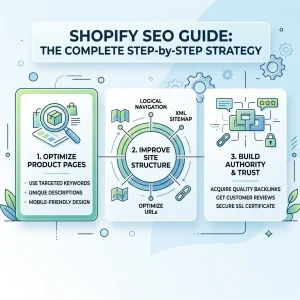
Shopify has closed much of the gap that used to exist here, with solid built-in SEO controls and a growing app ecosystem for advanced needs. Store owners specifically on Shopify benefit from resources like our Shopify SEO guide, which walks through the platform-specific settings and constraints worth knowing before optimizing a Shopify store for search.
Shopify vs WooCommerce: Scalability and Performance
Shopify’s hosted infrastructure is built to handle traffic spikes without the store owner needing to think about server capacity, which matters enormously during high-traffic moments like a product launch or a seasonal sale. This reliability is part of what Shopify charges for, and it removes a significant operational burden from a growing business.
WooCommerce’s scalability depends entirely on your hosting choice and how well the site is optimized. A well-configured WooCommerce store on quality hosting can absolutely handle serious traffic, but the responsibility for making sure that happens sits with you rather than the platform. This is a meaningful consideration for a business that expects rapid growth and doesn’t want to manage server infrastructure as a side project.
Apps, Plugins, and the Ecosystem
Shopify’s app store covers an enormous range of functionality — marketing tools, inventory management, customer support, and more — all built to integrate cleanly with the core platform. Running paid acquisition alongside a Shopify store is also well supported, and resources like our guide on using Google Ads for a Shopify store and integrating Shopify with Facebook Ads reflect how mature that ecosystem has become for marketing specifically.
WooCommerce benefits from the entire WordPress plugin ecosystem, which is enormous and covers nearly any functionality imaginable, though quality and maintenance vary far more than in Shopify’s curated app store. This means more options, but also more due diligence required before relying on a given plugin for critical store functionality.
Shopify vs WooCommerce: Support and Community
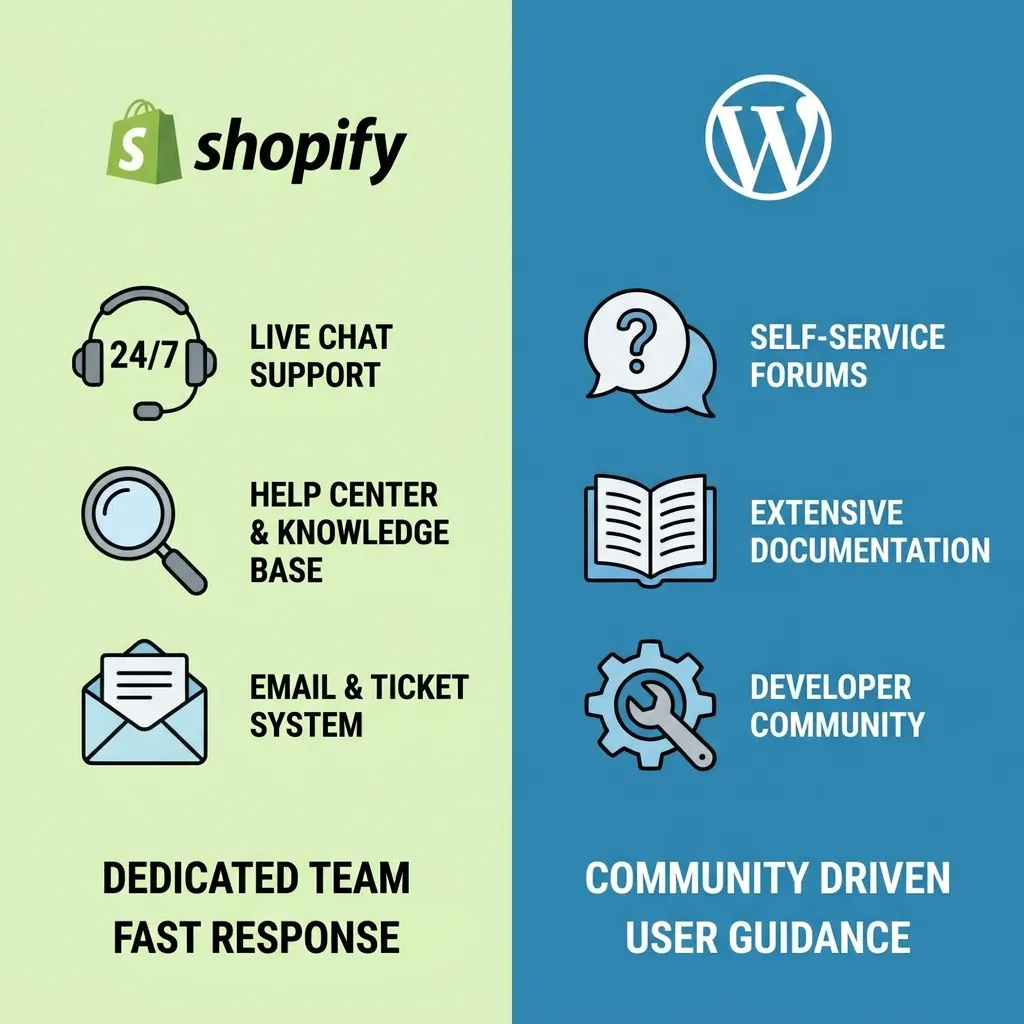
Shopify offers direct customer support as part of its hosted service, along with extensive documentation and a large community of users sharing solutions to common problems. When something breaks, there’s a clear path to getting help from the platform itself.
WooCommerce doesn’t offer centralized support in the same way, since it’s an open-source plugin rather than a company running your store’s infrastructure. Support instead comes from the broader WordPress and WooCommerce community, individual plugin developers, or hired freelancers and agencies. This can work well for a store owner with some technical comfort, but it’s a meaningfully different support experience than a hosted platform provides.
Which Platform Fits Which Type of Business
When weighing Shopify vs WooCommerce, a useful way to decide is to think about what kind of founder and business you actually are, rather than which platform is “better” in the abstract:
- Choose Shopify if you want to launch quickly without managing hosting or technical infrastructure, you value predictable costs and dedicated support, and your customization needs fit within a strong app ecosystem.
- Choose WooCommerce if you already have a WordPress site, you or your team are comfortable with some technical setup, you need highly specific customization, or minimizing platform fees matters more than convenience.
Neither choice is permanent, but migrating an established store between platforms later is a significant project, so it’s worth being honest about which category actually describes your situation before committing.
Shopify vs WooCommerce: Total Cost of Ownership in Year One
Comparing sticker prices alone misses a lot of what actually gets spent running a store in its first year. On Shopify, the core subscription is just one line item — most stores also pay for a handful of premium apps for email marketing, reviews, or upselling, plus occasional theme customization work. Even after adding those extras, total costs tend to stay fairly predictable month to month, since Shopify bundles hosting and infrastructure into the base price.
On WooCommerce, the “free” plugin quickly picks up real costs: quality hosting built for ecommerce traffic, an SSL certificate, a handful of premium plugins for functionality Shopify includes by default, and likely some developer time for setup or troubleshooting along the way. For a very small store with minimal customization needs, this can still land below Shopify’s total cost. For a store that wants a polished, fully-featured experience comparable to what Shopify offers out of the box, the gap narrows considerably once hosting quality and plugin costs are factored in honestly.
The real comparison isn’t free versus paid — it’s predictable, bundled cost versus variable, self-assembled cost. Deciding which model fits your budget and risk tolerance is often more useful than comparing headline pricing numbers in isolation.
What Successful Stores on Each Platform Have in Common
Looking at thriving stores on both platforms reveals a consistent pattern that has less to do with the platform itself and more to do with how deliberately it’s used. Successful Shopify stores tend to invest heavily in a small number of well-chosen apps rather than bolting on dozens of overlapping tools, and they lean into the platform’s strengths around fast checkout and reliable performance during high-traffic events. Successful WooCommerce stores, on the other hand, typically have either an in-house developer or a strong ongoing relationship with an agency, since that technical support is what lets them take full advantage of the platform’s flexibility without it becoming a maintenance burden.
This pattern suggests that the Shopify vs WooCommerce decision matters less in isolation than how well-matched the platform is to the resources and skills already available on the team running the store. A technically strong team with time to invest can make WooCommerce sing; a lean team that wants to focus purely on products and marketing usually gets there faster with Shopify.
A similar principle shows up when comparing tools in other areas of a marketing stack. The way evaluates different brand advocacy platforms makes a comparable point — the best platform choice is the one that matches the team’s existing workflow and resources, not necessarily the one with the longest feature list.
Common Mistakes When Choosing Between the Two
- Picking based on price alone. WooCommerce’s “free” plugin cost often gets offset by hosting, plugins, and development time that add up to a similar or higher total cost.
- Underestimating the technical commitment of WooCommerce. Store owners without technical support sometimes underestimate how much ongoing maintenance a self-hosted platform requires.
- Assuming Shopify can’t be customized. Shopify’s app ecosystem and theme customization options cover far more ground than many first-time users expect.
- Ignoring long-term scalability needs. A platform that works fine at low traffic volumes may need significant rework once a store starts scaling quickly.
- Not planning for marketing tool integration. Whichever platform you choose, make sure it connects cleanly with the specific marketing tools and channels your business plans to use.
A Broader Lesson From Platform Comparisons

Deciding between two capable platforms is a recurring theme across marketing and business tools generally, not just ecommerce. The same evaluation logic that applies to Shopify vs WooCommerce shows up in webinarmarketo’s comparison of the best webinar platforms — the “best” option depends entirely on the specific priorities of the person choosing, not a universal ranking. Whether it’s ecommerce, webinars, or any other category of business software, the right question is rarely “which tool is objectively best” but “which tool fits how we actually plan to operate.”
Making the Final Decision
If you’re still torn after weighing Shopify vs WooCommerce on every factor above, it often helps to think about which trade-off you’d rather live with day to day. Shopify asks you to accept somewhat less flexibility in exchange for a smoother, more predictable operating experience. WooCommerce asks you to accept more responsibility and setup complexity in exchange for control and a lower baseline cost. Neither trade-off is wrong, but one of them will almost certainly feel more comfortable given your team’s skills, budget, and appetite for hands-on technical work.
It’s also worth considering how each platform will support your broader marketing plans, not just the storefront itself. A store built for strong content and video marketing, for example, benefits from a platform that integrates cleanly with tools built for that purpose — our guide to video marketing for ecommerce is a useful read regardless of which platform you land on, since the underlying strategy for using video to drive ecommerce sales applies to both.
Conclusion
There’s no universally correct answer to Shopify vs WooCommerce — the right choice depends on your budget, technical comfort, customization needs, and how much control you want over the underlying infrastructure. Shopify offers a faster, more managed path with predictable costs and dedicated support, while WooCommerce offers greater flexibility and a lower entry price at the cost of more hands-on setup and maintenance. Evaluate your own priorities honestly against the comparisons above, and choose the platform that matches how you actually want to run your store, not just which one sounds more popular.
Frequently Asked Questions
Shopify vs WooCommerce: Which Is Better for Beginners?
Shopify is generally easier for beginners since it’s fully hosted and doesn’t require managing separate hosting, security, or technical infrastructure to get started.
Shopify vs WooCommerce: Which One Is Cheaper?
WooCommerce can be cheaper for small stores since the plugin itself is free, but hosting, plugins, and development costs often close much of that gap as a store grows.
Can I Switch From WooCommerce to Shopify Later, or Vice Versa?
Yes, but migrating an established store between platforms is a significant project involving product data, customer records, and potentially a full redesign, so it’s worth choosing carefully upfront.
Shopify vs WooCommerce: Which Has Better SEO?
Both can perform well for SEO, though WooCommerce’s WordPress foundation gives it a slight edge for content-heavy SEO strategies, while Shopify has closed much of that gap with improved built-in tools.
Which Platform Is More Customizable?
WooCommerce offers more customization since it’s open-source and built on WordPress, while Shopify’s customization is more constrained but covers most common needs through its app and theme ecosystem.
Do I Need Coding Skills to Use WooCommerce?
Not strictly, but a working knowledge of WordPress and comfort troubleshooting plugins makes WooCommerce significantly easier to manage without hiring outside help.
Shopify vs WooCommerce: Which Scales Better?
Shopify’s hosted infrastructure generally handles rapid growth and traffic spikes more smoothly, since the platform manages server capacity rather than leaving that responsibility to the store owner.
Which Platform Has Better Customer Support?
Shopify offers direct customer support as part of its hosted service, while WooCommerce relies on community support, plugin developers, and third-party agencies rather than centralized support.
Can I Run Paid Ads Effectively on Both Platforms?
Yes, both platforms support integration with major ad channels, though Shopify’s app ecosystem tends to make ad platform integrations somewhat more straightforward to set up.
Is WooCommerce a Good Choice If I Already Have a WordPress Site?
Yes, WooCommerce is often the more natural choice if you already have an established WordPress presence, since it integrates directly rather than requiring a separate platform.
Which Platform Is Better for a Highly Custom Store Design?
WooCommerce generally offers more design freedom since developers can modify the underlying code directly, while Shopify’s design flexibility is bounded by its theme and app framework.
What’s the Biggest Factor to Consider When Choosing Between Them?
How much technical responsibility you’re willing to take on: Shopify trades some flexibility for a managed, hands-off experience, while WooCommerce trades convenience for greater control.